
Peptide Research
The Ultimate Guide to Bac Water for Reconstitution (7 Key Facts)
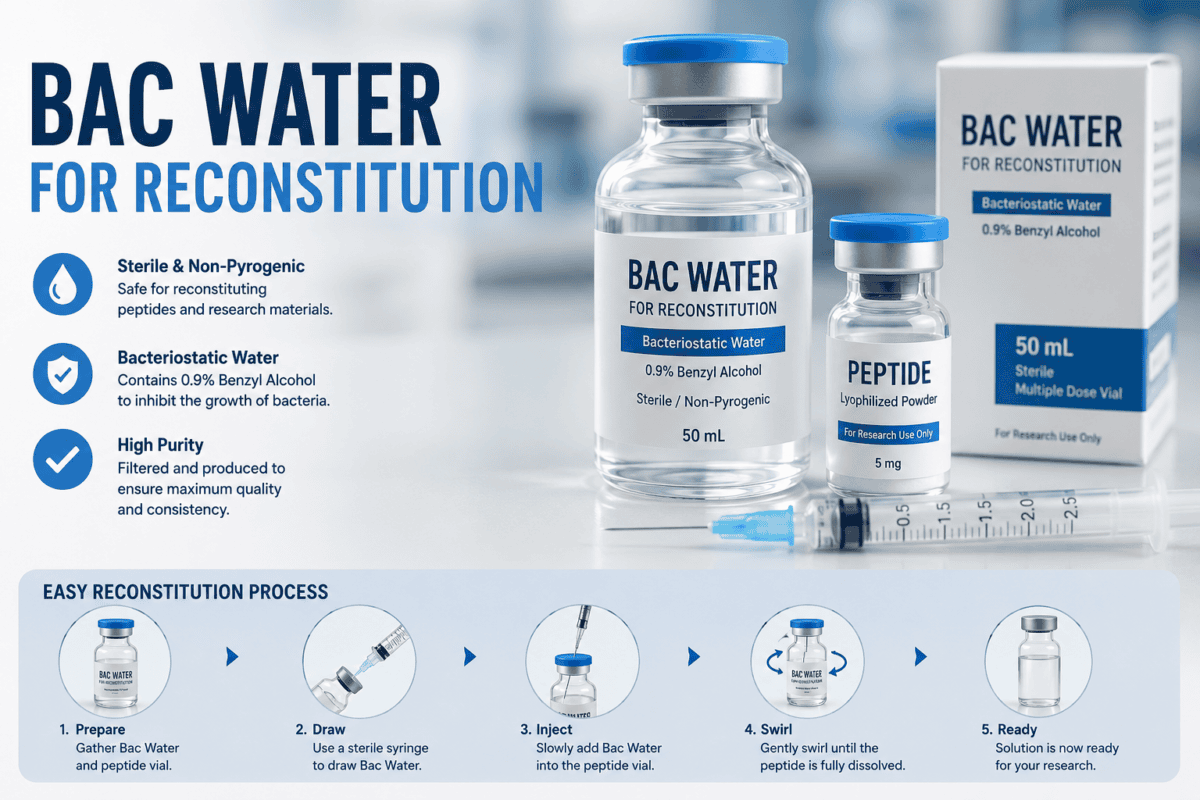
7 Things to Know About Bac Water for Reconstitution: Uses, Differences, Safety & Storage
If you’ve ever stood in front of a small glass vial, syringe in hand, and wondered exactly what that clear liquid labeled “bacteriostatic water” actually does — you’re not alone. It’s one of those terms that gets tossed around in pharmacy conversations, research settings, and patient instructions, but rarely gets properly explained.
This guide breaks down bac water for reconstitution in plain language, covering seven core things every reader should understand: what bacteriostatic water is, why it’s used as a diluent for injectable medications, how it’s different from plain sterile water, and the safety, storage, and sterility considerations that matter before working with it. Think of this as the conversation a knowledgeable friend would have with you — the one who explains things clearly instead of burying you in jargon.
A quick but important note before we dive in: this article is educational. It explains concepts and terminology — it is not a substitute for instructions from a pharmacist, physician, or product labeling, and it does not provide dosing calculations for any specific medication. Always follow the guidance of a licensed healthcare professional and the labeling that comes with your specific product.
1. What Is Bacteriostatic Water?
Bacteriostatic water is sterile water that has one key ingredient added to it: benzyl alcohol, typically at a concentration of about 0.9% (some formulations use 1.1%). That small addition changes everything about how the water behaves once a vial is opened.
Plain sterile water is sterile only until the seal is broken. The moment a needle punctures the rubber stopper, that water is exposed to air, and with it, the possibility of bacterial contamination. Bacteriostatic water, on the other hand, contains a preservative that actively slows or halts the growth of bacteria inside the vial after it’s been opened and used multiple times.
The word itself explains the function: “bacterio-” refers to bacteria, and “-static” means to keep something in a stationary, non-growing state. So bacteriostatic water meaning, in the simplest terms, is water that keeps bacteria from multiplying — not necessarily water that kills bacteria outright, but water that creates an environment where they can’t thrive.
This distinction matters enormously in clinical and research settings, where a single vial of diluent might be used for multiple reconstitutions over several days or weeks — which is exactly why so many people search for bac water for reconstitution rather than plain water in the first place.
2. Bac Water vs Sterile Water: What’s the Real Difference?
This is one of the most common points of confusion, and it deserves a clear answer.
Sterile water for injection is water that has been purified and sterilized, with no bacteriostatic agent added. It’s designed for single use. Once the vial is opened, it’s meant to be used once and then discarded — it offers no ongoing protection against contamination.
Bacteriostatic water, by contrast, is formulated for repeated access. Because of the added benzyl alcohol, it can typically be used for multiple withdrawals from the same vial over a period of time (commonly up to 28 days after first use, though this varies by manufacturer and should always be confirmed on the product label).
Here’s a simple way to picture the difference between bac water and sterile water: imagine sterile water as a fresh loaf of bread with no preservatives — perfect the moment it’s cut open, but starting to mold within a day or two once exposed to air. Bacteriostatic water is more like bread with a mild preservative baked in — it still won’t last forever, but it holds up much longer under repeated handling.
There’s also an important safety caveat that gets asked about often: bacteriostatic water is not appropriate for every situation. Because of the benzyl alcohol content, it is not used in neonates and in certain other specific clinical circumstances, where plain sterile water or another approved diluent is used instead. This is exactly the kind of decision that should be made by a healthcare provider, not by a patient or caregiver on their own.
3. Why Is Bacteriostatic Water Used as a Diluent?
A diluent for injectable medications is simply the liquid used to dissolve a powdered or freeze-dried (lyophilized) medication so it can be measured and administered accurately.
Many injectable medications, including certain hormones, biologics, and research compounds, are manufactured and shipped as a dry powder. This isn’t a shortcut or an inconvenience — it’s often the only way to keep the substance chemically stable during storage and transport. Once dissolved in liquid, many of these compounds have a limited window of stability, so manufacturers freeze-dry them and leave reconstitution to the point of use.
This is where bac water for reconstitution comes in as a diluent. Because it can be safely accessed more than once without introducing significant contamination risk (when handled properly), it’s a practical choice anywhere a vial of dissolved medication needs to be drawn from multiple times rather than used up in a single dose.
Registered nurses and compounding pharmacists often describe it in straightforward terms: it’s not about making the medication “stronger” or “weaker,” it’s about creating a stable, measurable liquid form of something that started out as a dry powder — and doing so in a way that keeps the vial usable for as long as possible after it’s opened.
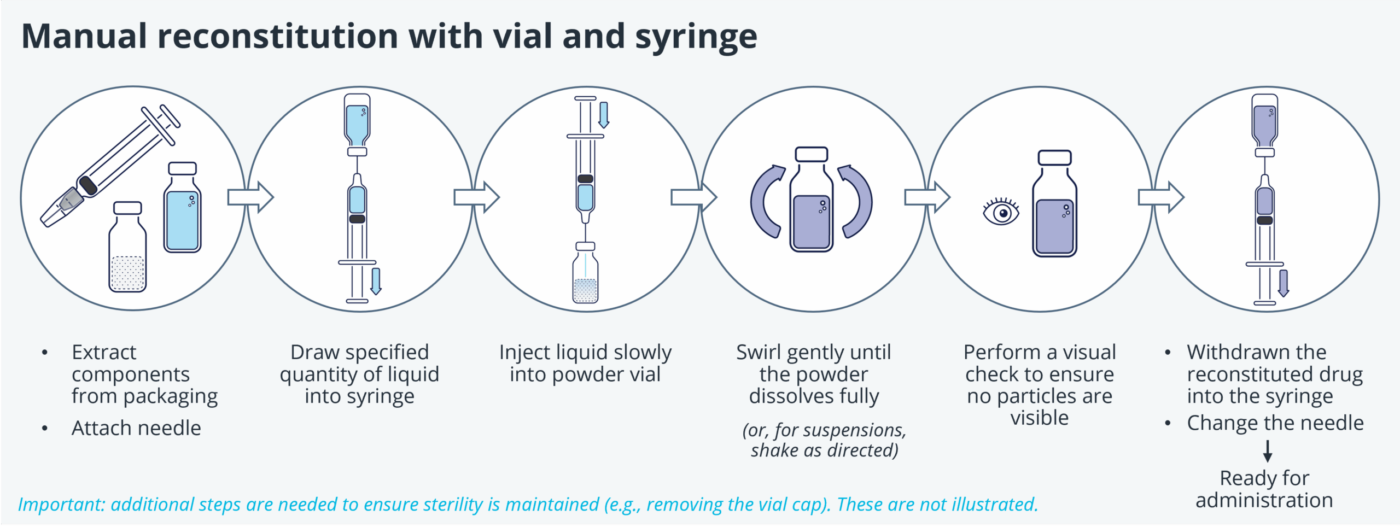
4. How Does Reconstitution With Bac Water for Reconstitution Work?
Reconstitution is the general process of adding a liquid to a powdered substance to dissolve it into a usable solution. Understanding how bac water for reconstitution works conceptually is genuinely useful — even though the specific amount of diluent used for any individual product is not something a general guide should specify, because it depends entirely on the exact medication, its concentration, and the instructions provided by the manufacturer or prescribing clinician.
At a conceptual level, three things determine the outcome of any reconstitution:
- The amount of active substance in the vial (measured in milligrams or micrograms), as printed on the vial label.
- The volume of diluent added (measured in milliliters), which is specified by the product’s official instructions or a healthcare provider.
- The resulting concentration, which is simply the amount of substance divided by the volume of liquid it’s dissolved in.
Change the volume of diluent, and you change the concentration — but not the total amount of medication in the vial. This is a point that trips a lot of people up: reconstituting with more or less bacteriostatic water doesn’t add or remove medication, it changes how concentrated that medication is per milliliter, which in turn changes how it should be measured out.
Because getting this wrong has real consequences, the specific ratio for any product should always come from the manufacturer’s labeling or from a pharmacist or prescriber — never from a generic online source, a forum post, or an approximate formula. If you have a specific vial in front of you and aren’t sure how much diluent to use, the safest next step is a phone call to a pharmacist, not a guess.
Once the powder is fully dissolved, the vial should look clear (unless the product’s labeling states otherwise) with no visible particles. Gently rolling or swirling the vial — rather than shaking it — is the generally recommended technique, since vigorous shaking can degrade certain proteins and peptides through a process called denaturation.
5. Is Bacteriostatic Water Safe?
Is bacteriostatic water safe is one of the most frequently asked questions about bac water for reconstitution, and the honest answer is: it’s safe when it’s manufactured to pharmaceutical-grade standards, handled properly, used within its labeled expiration window, and used for its intended purpose under appropriate guidance.
That said, “safe” comes with real conditions attached:
- It should be pharmaceutical or research-grade, sourced from a reputable supplier, not an unverified or unlabeled source.
- It should never be used past its opened-vial expiration date, typically 28 days, though this should always be confirmed against the specific product label.
- It should be stored correctly (more on that below).
- It should be used with a new, sterile needle and syringe every time a vial is accessed, to minimize contamination risk.
- It is a diluent, not a treatment in itself. Injecting bacteriostatic water alone provides no therapeutic benefit — the benzyl alcohol content means it can cause local irritation, and larger volumes are not appropriate for injection without medical guidance. If you’re wondering what happens if bacteriostatic water is injected on its own, the short answer is: it isn’t intended to be, and doing so serves no medical purpose.
6. How Long Does Bacteriostatic Water Last? Storage and Expiration
How long does bacteriostatic water last depends on whether the vial has been opened.
Unopened vials: When stored properly (typically at room temperature, away from direct light, per the manufacturer’s label), an unopened vial generally remains stable until the expiration date printed on the packaging — often one to several years from manufacture.
Opened vials: Once the rubber stopper has been punctured, the clock starts ticking. Most manufacturers state that an opened vial should be used within 28 days, after which it should be discarded, even if there appears to be liquid remaining. This is a widely cited industry standard, though it’s always worth double-checking the specific product’s labeling, since it can vary.
A few practical bacteriostatic water storage tips that pharmacists commonly emphasize for anyone keeping bac water for reconstitution on hand:
- Store opened vials in the refrigerator (again, confirm against the label — some products specify room temperature instead).
- Keep the vial away from direct sunlight.
- Never freeze it, as freezing can compromise the solution.
- Label the vial with the date it was first opened, so you have a clear reference point for the 28-day window.
- Discard any vial that looks cloudy, discolored, or has visible particles floating in it, regardless of how many days have passed.
Think of this less like a rigid rule and more like the “sniff test” people apply to food: even within an expiration window, if something looks off, it’s not worth the risk.
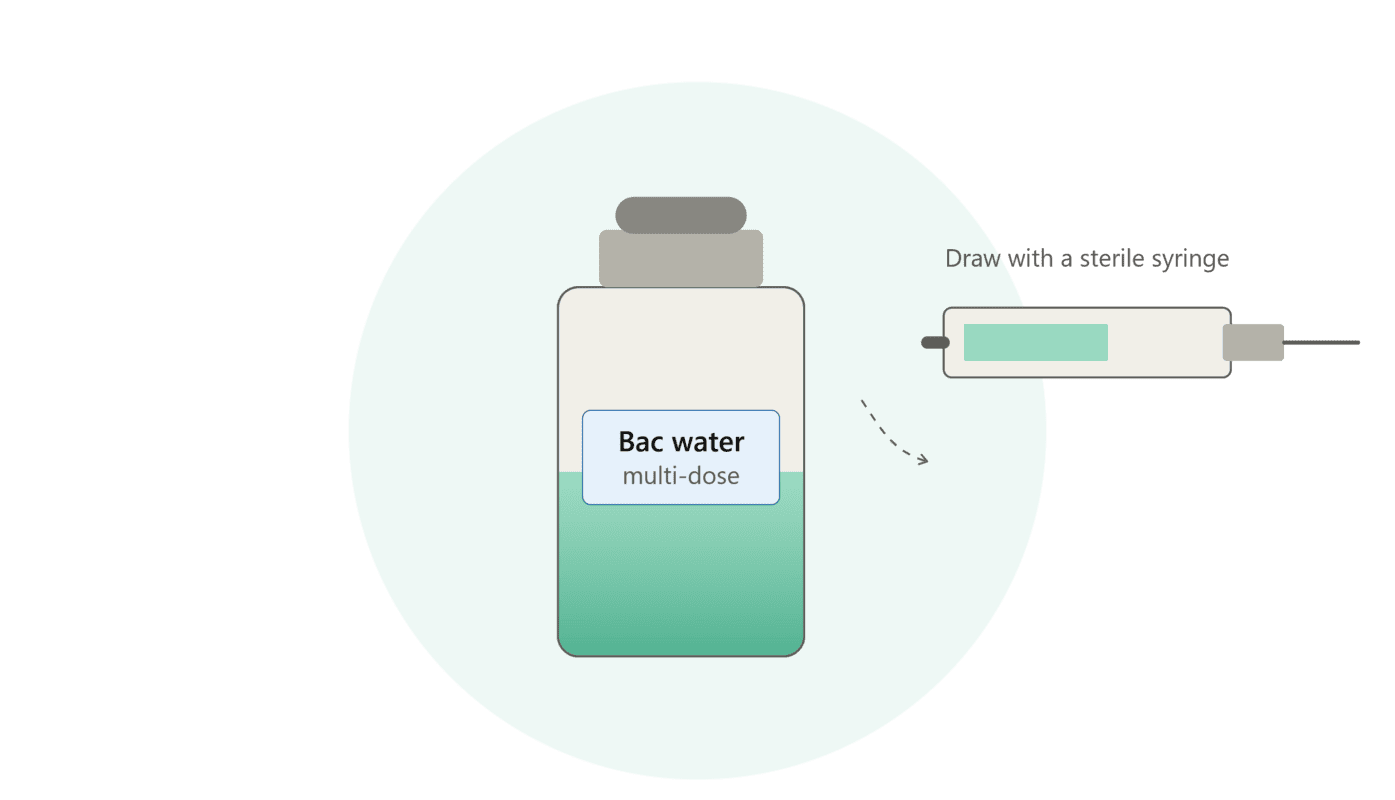
7. Bacteriostatic Water Sterility: What “Sterile” Really Means Here
Bacteriostatic water sterility is worth unpacking, because “sterile” and “bacteriostatic” aren’t quite the same thing, and conflating them can lead to a false sense of security.
The water itself is manufactured under sterile conditions and is sterile at the moment the vial is sealed. The benzyl alcohol doesn’t make it “more sterile” — what it does is slow the growth of any bacteria that might be introduced later, during repeated needle access. It’s a maintenance mechanism, not an initial sterilization process.
This is why proper technique still matters enormously, even with a bacteriostatic formulation:
- Always wipe the rubber stopper with an alcohol swab before inserting a needle.
- Use a new, sterile needle and syringe for every withdrawal.
- Never touch the needle tip to any non-sterile surface.
- Avoid leaving the vial uncapped or exposed to open air for longer than necessary.
Bacteriostatic water buys you a margin of safety over repeated use — it doesn’t eliminate the need for careful, sterile handling every single time.
Where Can You Get Bacteriostatic Water?
Can I buy BAC water at a pharmacy — yes, in many regions bacteriostatic water is available through pharmacies, typically requiring a prescription depending on local regulations, since it’s classified as a prescription diluent in many jurisdictions. Some research suppliers also offer bacteriostatic water labeled specifically for laboratory or research use, which is manufactured to a different regulatory standard than pharmacy products intended for human injection.
It’s worth being genuinely careful here. Because the liquid itself looks identical regardless of its source or grade, buying from an unverified or unlabeled supplier introduces real risk. Reputable suppliers provide batch testing documentation, clear labeling, and traceable manufacturing standards — details worth confirming before use.
When to Use Bacteriostatic Water for Reconstitution
When to use bacteriostatic water ultimately comes down to what’s specified for the particular product you’re working with. As a general pattern, it tends to be the diluent of choice when:
- A medication or compound is supplied as a lyophilized (freeze-dried) powder.
- The product’s labeling or a healthcare provider specifically calls for a bacteriostatic diluent rather than plain sterile water.
- The vial is expected to be accessed more than once over a period of days or weeks, rather than used entirely in one draw.
Why use bacteriostatic water for reconstitution rather than plain sterile water, in these cases, comes down to that extended usability window. It’s a practical solution to a practical problem: how do you keep a multi-dose vial safe to use for weeks instead of hours?
A Quick Real-World Analogy
Picture two identical bottles of fresh-squeezed orange juice. One has no preservative — open it, and you’ve got about a day before it starts to turn. The other has a small amount of a safe preservative added, extending its usable life to a few weeks in the fridge, even with the cap going on and off regularly.
Neither bottle is “better” juice. They’re the same juice. The difference is purely about how the container behaves after it’s been opened and handled repeatedly. That’s essentially the relationship between sterile water and bacteriostatic water — same core substance, different behavior once real-world use begins.
Common Questions About Bac Water for Reconstitution, Answered Directly
What is bacteriostatic water for reconstitution? It’s sterile water containing a small amount of benzyl alcohol, used to dissolve powdered medications into a liquid, measurable form, while remaining safer for repeated access over time than plain sterile water.
How many mL is in a vial of BAC water? Vial sizes vary by manufacturer — common sizes include 10 mL and 30 mL multi-dose vials, though this differs by product and supplier, so always check the specific vial’s label.
How much BAC water should I use to reconstitute a specific medication? This depends entirely on the specific product, its concentration, and the instructions provided by its manufacturer or your prescribing clinician. There is no universal ratio, and using an approximate or generic figure found online is not a safe substitute for product-specific labeling or professional guidance.
Is 1 mL of BAC water 100 units on a syringe? On a standard U-100 insulin-style syringe, 1 mL is generally marked as 100 units, since that syringe type is calibrated specifically to that scale. This is a statement about the syringe’s markings, not about medication dosing, which depends entirely on concentration and should be confirmed with a pharmacist or provider.
What happens if I inject just bacteriostatic water? It provides no therapeutic effect on its own. Because it contains benzyl alcohol, injecting it isn’t harm-free either — it can cause local irritation at the injection site. It’s intended purely as a diluent, not as a substance to be administered by itself.
How do I calculate reconstitution amounts correctly? The safest approach is to follow the manufacturer’s official product labeling or the specific instructions given by a pharmacist or prescribing clinician for that exact product. General guides (including this one) intentionally don’t provide product-specific calculations, because getting them wrong carries real risk.
Choosing a Quality Bac Water for Reconstitution Product
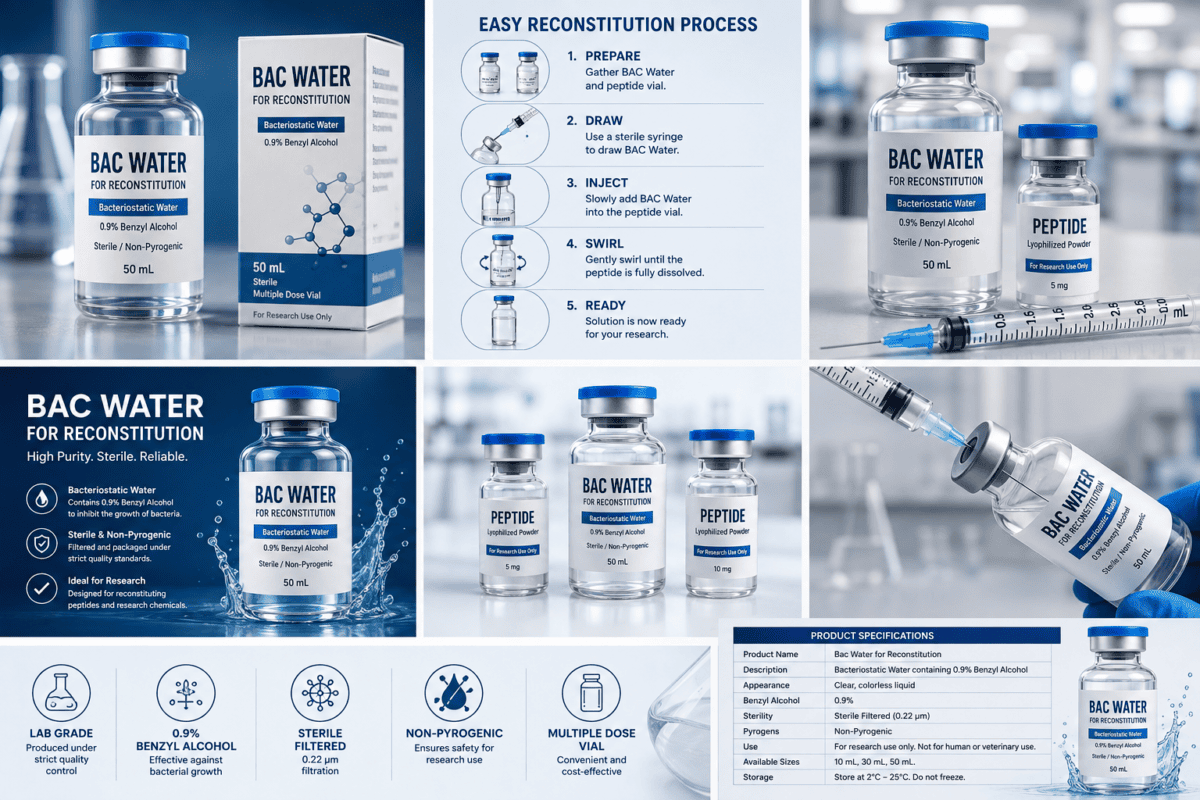
Not all bac water for reconstitution is manufactured to the same standard, and the source matters just as much as the technique. Before you rely on any bac water for reconstitution, it’s worth knowing what separates a trustworthy product from a risky one.
Look for pharmaceutical or USP-grade labeling.
Reputable bac water for reconstitution will clearly state the benzyl alcohol concentration (0.9% or 1.1%), the lot number, and an expiration date printed directly on the vial. If a product is missing this basic labeling, that’s a red flag regardless of how it’s marketed.
Check for batch testing and traceability.
suppliers of bac water for reconstitution can typically provide a certificate of analysis on request, showing the product was tested for sterility and purity before it reached the shelf. This kind of documentation is standard for pharmacy-grade diluents and increasingly common among reputable research suppliers as well.
Match the grade to the intended use.
Bac water for reconstitution labeled specifically for human injectable use (typically dispensed through a pharmacy) is held to a different regulatory standard than water labeled strictly for laboratory or research purposes. Confusing the two, or assuming research-grade material is automatically safe for injection, is a common and avoidable mistake.
Inspect every vial before use, every time.
Regardless of how reputable the source, a quality check takes seconds: hold the vial to the light and confirm the liquid is clear, colorless, and free of particles. A compromised vial should be discarded immediately, no matter how much product remains inside it.
Quick reference checklist
- Confirm benzyl alcohol concentration and expiration date are printed on the label
- Verify the source can provide batch testing documentation if asked
- Match the product grade (pharmacy vs. research) to your actual intended use
- Use a new sterile needle and syringe for every withdrawal
- Discard any vial more than 28 days after first puncture, or sooner per the label
- Never use a vial that looks cloudy, discolored, or has visible particles
The Bottom Line
Bac water for reconstitution plays a genuinely useful, well-understood role in preparing certain injectable medications — it dissolves powdered compounds into a liquid form and, thanks to its benzyl alcohol content, remains usable for repeated access over a period of weeks rather than a single use.
Understanding the terminology — how it differs from plain sterile diluent for reconstitution, how it should be stored, and how sterility is maintained even with a bacteriostatic formulation — helps patients, caregivers, and researchers have more informed conversations with the professionals guiding their care.
What it isn’t is a do-it-yourself dosing system. The specific volume of bacteriostatic water used for any given medication, the resulting concentration, and the correct dose to draw up are decisions that belong with product labeling and licensed healthcare professionals — not generic online formulas. If you’re working with a specific medication and have questions about your particular vial, the right next step is always a conversation with your pharmacist or prescribing clinician.
Further Reading
For readers who want to go straight to the primary source material referenced in this guide, these are official pharmaceutical labeling and reference resources:
- Bacteriostatic Water for Injection, USP — full FDA-sourced prescribing label, DailyMed / U.S. National Library of Medicine
- Bacteriostatic Water for Injection — package insert and prescribing information, Drugs.com
- Bacteriostatic Water — uses, dosage, and warnings overview, RxList
- Benzyl Alcohol Topical — drug information, MedlinePlus / U.S. National Library of Medicine
- FDA Drugs@FDA — official drug labeling search
Perfectly said and also a good article 💯💯