Peptide Research
BPC-157 Peptide Benefits: What’s Proven vs. Overhyped
BPC-157 Peptide Benefits: The Promising, Unproven Truth Behind the Hype
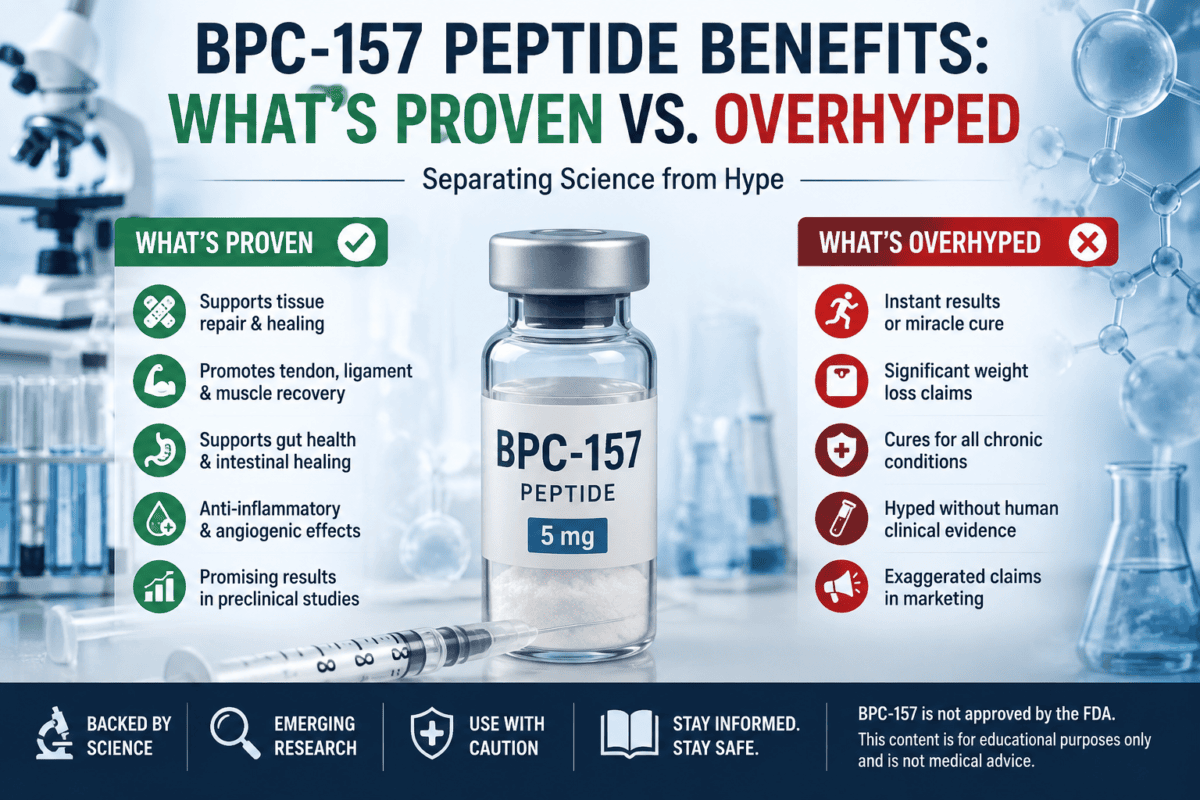
If you’ve spent any time in recovery-focused corners of the internet — a physical therapy forum, a strength-training subreddit, a biohacking group chat — you’ve probably run into the name BPC-157. It shows up in conversations about torn tendons, stubborn guts, and injuries that just won’t quit. The claims are bold: faster healing, calmer inflammation, a gut that finally behaves.
Here’s the catch. Most of what’s circulating about BPC-157 peptide benefits comes from rodent studies, not people. That doesn’t make the science uninteresting — it’s actually a genuinely active and promising area of research — but it does mean the gap between “what a petri dish or a rat model showed” and “what this does in a human body” is still wide open.
This article walks through what researchers have actually observed about BPC-157 peptide benefits, where the evidence is solid versus speculative, what the BPC-157 peptide benefits and risks picture looks like side by side, and what’s still an open question — including where things stand legally in 2026, because that’s changed more in the last year than in the previous decade.
Table of Contents
- What Is BPC-157?
- How Does BPC-157 Work in the Body?
- BPC-157 Tissue Repair Benefits: What Animal Studies Show
- BPC-157 Gastrointestinal Benefits and Gut Health Research
- BPC-157 Peptide Benefits at a Glance (Summary Table)
- Is BPC-157 Effective for Healing? What Research Does and Doesn’t Show
- Are BPC-157 Peptide Benefits Proven in Humans?
- BPC-157 Safety and Side Effects
- BPC-157 Peptide Benefits and Risks: A Balanced View
- Is BPC-157 Legal? The 2026 Regulatory Picture
- BPC-157 vs. TB-500: How Do They Compare?
- Limitations of Current BPC-157 Research
- Frequently Asked Questions
What Is BPC-157?
BPC-157 (Body Protection Compound-157) is a synthetic pentadecapeptide — a chain of 15 amino acids — modeled on a protective protein sequence found naturally in human gastric juice. Researchers isolated the parent compound decades ago while studying what keeps the stomach lining intact despite constant exposure to acid.
That origin story is part of why so much early BPC-157 gut health research exists: scientists were originally chasing gastrointestinal protection, and the healing-related findings in tendons, muscle, and other tissue came later, as researchers noticed the peptide’s effects seemed to extend well beyond the stomach.
Structurally, it’s a small, stable peptide — which is part of its appeal to researchers, since many peptides break down too quickly in the body to study easily. According to the compound’s technical profile on Wikipedia, BPC-157 has been studied primarily in laboratory animals and is not approved by any drug regulatory agency for human use, with limited data on its effectiveness in humans — a summary that lines up closely with what the peer-reviewed literature shows.
| Property | Detail |
|---|---|
| Full name | Body Protection Compound-157 |
| Structure | Pentadecapeptide (15 amino acids) |
| Origin | Sequence derived from a human gastric juice protective protein |
| Primary research areas | Tissue repair, gastrointestinal protection, inflammation |
| FDA approval status | Not approved |
| Completed human trials | None published at scale |
| Legal category (2026) | Under active regulatory review; not approved for human use |
How Does BPC-157 Work in the Body?
The honest answer: the mechanism of action isn’t fully mapped, and that’s true of a lot of experimental peptides. What preclinical research does point to is a handful of overlapping biological pathways that likely explain the broader BPC-157 peptide benefits researchers keep circling back to:
- Angiogenesis — the formation of new blood vessels, which matters because healing tissue needs a blood supply
- Nitric oxide signaling — involved in blood flow and tissue repair regulation
- Growth factor modulation — some animal studies show changes in growth factor expression at injury sites
- Anti-inflammatory pathway activity — reduced inflammatory markers in various rodent injury models
These are plausible, biologically reasonable mechanisms — and they’re consistent with why researchers keep circling back to tissue repair and gut healing as the two main areas of interest. But a plausible mechanism in a rat is not the same thing as proven clinical benefit in a person. That distinction matters throughout everything below, and it’s the single most important piece of context for evaluating any claim about BPC-157 peptide benefits you encounter online.
BPC-157 Tissue Repair Benefits: What Animal Studies Show
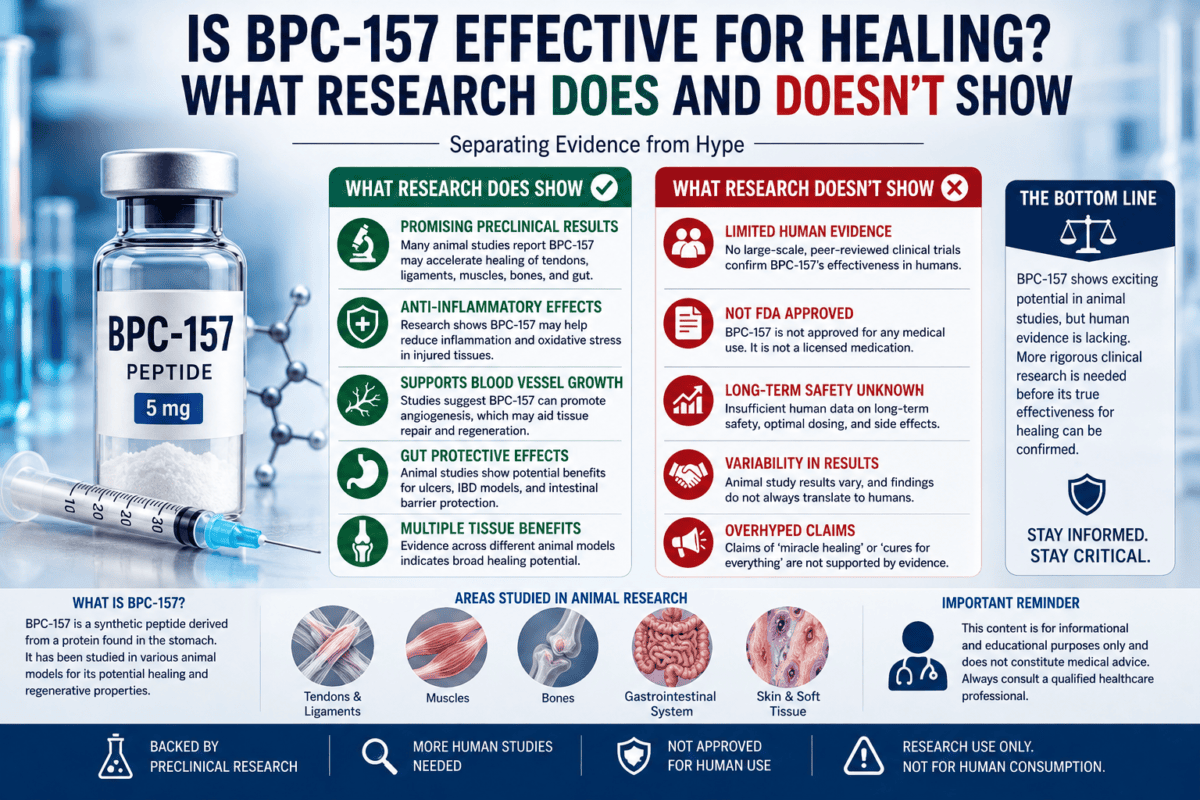
This is where most of the BPC-157 scientific evidence actually lives. Preclinical models — mostly rats and mice — have looked at BPC-157’s effects across several types of tissue injury. A detailed 2025 literature and patent review published in the journal Pharmaceuticals summarized decades of this work, describing BPC-157 as demonstrating pleiotropic beneficial effects across various preclinical models mimicking tissue injury, inflammatory bowel disease, and even central nervous system disorders — while explicitly noting it has not been approved for standard medical use due to a lack of comprehensive human clinical studies. You can read the full review on PubMed Central.
BPC-157 Tendon Healing Research
Several rodent studies have examined BPC-157 benefits for tendons, particularly around Achilles tendon injuries. Researchers have observed changes in collagen organization and healing markers at the injury site in treated animals compared to controls. Some studies also point to effects on tendon-to-bone attachment healing, which is a notoriously slow-healing type of injury even in ideal conditions.
BPC-157 Ligament Healing Research
Similarly, BPC-157 ligament healing research in animal models — including studies on ligament injuries around the knee — has reported accelerated healing markers relative to untreated controls. Again: these are lab-model observations, not clinical outcomes measured in human patients recovering from an ACL tear.
BPC-157 Muscle Recovery Benefits
For athletes and lifters, this is often the headline claim, and it’s a big part of why fitness and sports enthusiasts researching recovery-related claims gravitate toward this compound. Animal studies on muscle recovery and muscle-crush injuries have reported faster functional recovery in treated groups. It’s easy to see the appeal — but it’s worth being direct: there is no completed, published human clinical trial confirming that BPC-157 speeds muscle recovery in athletes.
BPC-157 Benefits for Joints
Joint-related research is thinner than the tendon and ligament literature, but some animal studies have looked at BPC-157 in models of joint injury and osteoarthritis-like damage, again with encouraging but preliminary results.
BPC-157 Gastrointestinal Benefits and Gut Health Research
Given its origins, it makes sense that BPC-157 gastrointestinal benefits remain one of the most-studied areas. Animal research has explored its effects in models of:
- Gastric ulcers
- Inflammatory bowel conditions
- Intestinal fistulas
- Medication-induced mucosal damage (including NSAID-related gut injury)
BPC-157 anti-inflammatory effects are a recurring theme across this GI research, with several studies reporting reduced inflammatory markers in treated animal models of intestinal injury. The FDA’s own Pharmacy Compounding Advisory Committee reviewed BPC-157 nominations specifically referencing ulcerative colitis in its July 2026 meeting materials, noting that other referenced uses, including Crohn’s disease and celiac disease, weren’t evaluated due to insufficient supporting clinical studies in the nomination.
BPC-157 Peptide Benefits at a Glance (Summary Table)
The table below summarizes what’s actually been studied, split by the strength of the underlying evidence. This is the fastest way to see the real shape of the BPC-157 potential benefits conversation.
| Area of Interest | Animal/Lab Evidence | Human Clinical Evidence | Research Status |
|---|---|---|---|
| Tendon healing | Multiple rodent studies, positive collagen/healing markers | None completed at scale | Preclinical only |
| Ligament repair | Positive markers in knee-ligament rodent models | None completed at scale | Preclinical only |
| Muscle recovery | Faster functional recovery in muscle-crush models | None completed at scale | Preclinical only |
| Gastrointestinal healing | Extensive rodent ulcer/IBD/fistula research | Small, early-stage studies only | Most-studied area, still preclinical-dominant |
| Anti-inflammatory effects | Reduced inflammatory markers across multiple models | Not established | Preclinical only |
| Joint health | Limited but positive early animal data | None | Early preclinical |
| General safety | Generally favorable short-term rodent safety data | Not established long-term | Ongoing scientific debate |
Is BPC-157 Effective for Healing? What Research Does and Doesn’t Show
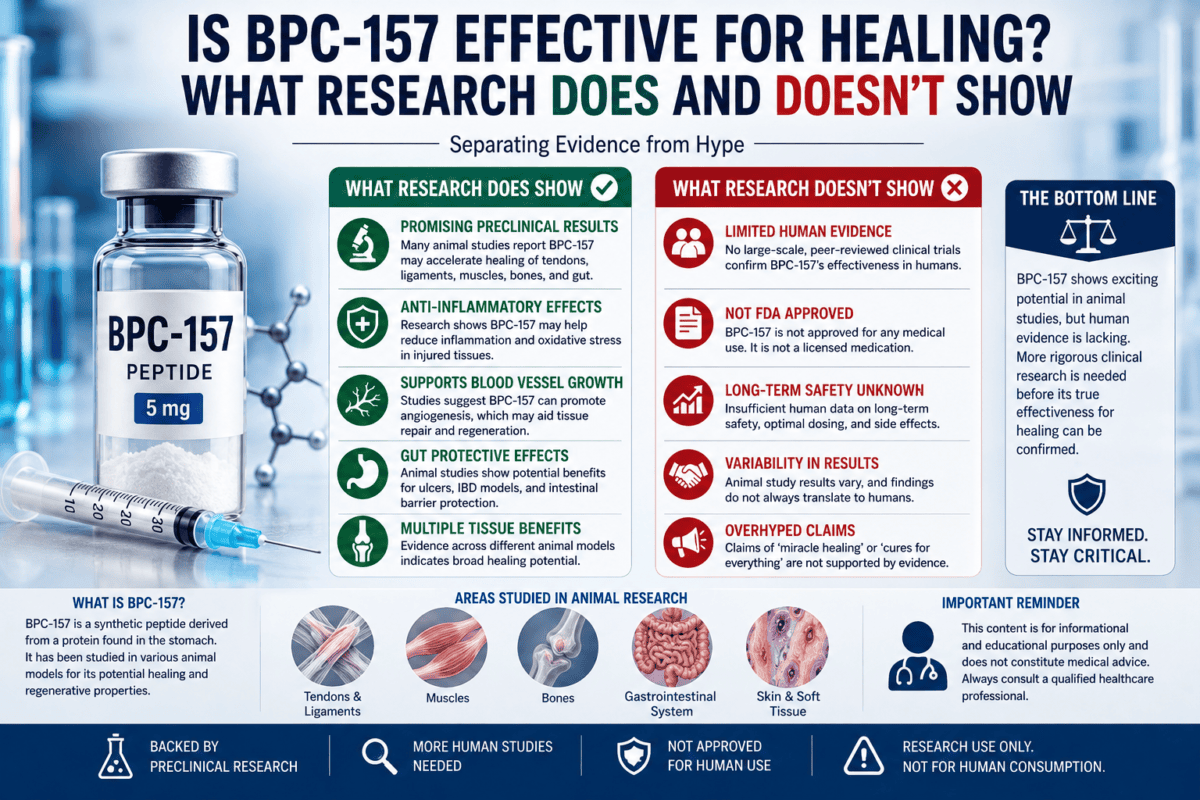
Here’s the balanced answer to one of the most common questions people ask: “Does BPC-157 promote tissue repair?”
In animal and laboratory models — yes, fairly consistently. Across tendon, ligament, muscle, and GI tissue, preclinical studies report favorable healing markers, which is exactly why interest in BPC-157 peptide benefits keeps growing among researchers and the wellness community alike.
In humans — the evidence is far thinner. A handful of small human studies, case reports, and early-phase investigations exist, but nothing has reached the size, randomization, or rigor needed to establish BPC-157 as a proven human therapy. Recent regulatory reviews have noted that human evidence remains extremely limited compared with the volume of claims circulating online, and that no completed late-stage human trials currently exist for this compound.
So when you see confident claims like “BPC-157 heals tendons” stated as settled fact — that’s getting ahead of the science. A more accurate framing is: animal research consistently suggests a healing effect worth studying further in humans, but that hasn’t yet been established through completed human clinical trials.
Are BPC-157 Peptide Benefits Proven in Humans?
Not in the way “proven” is used for approved medications. To put this plainly:
- No BPC-157 product has completed FDA-reviewed Phase II or Phase III human trials
- There is no active Investigational New Drug (IND) application on file
- ClinicalTrials.gov does not show completed, large-scale human trials establishing efficacy
This doesn’t mean the underlying research is fake or worthless — early-stage, mechanism-driven, animal research is a completely normal (and necessary) part of how any compound moves toward eventually being studied in people. It just means BPC-157 is still early in that pipeline, not at the end of it. Until that changes, any specific claim about BPC-157 peptide benefits in humans should be read as a hypothesis under investigation, not a settled conclusion.
BPC-157 Safety and Side Effects
Is BPC-157 safe? This is one of the most-asked questions, and the honest answer is: safety in humans hasn’t been formally established, because the large-scale, long-term human safety studies that would answer that question definitively don’t yet exist.
What’s known:
- Animal studies have generally reported a favorable safety profile at the doses tested, with relatively few adverse effects observed in short-term rodent studies
- Because BPC-157 is not manufactured under FDA-regulated pharmaceutical conditions when sold as a research chemical, product purity and quality vary significantly between suppliers
- Long-term effects of repeated human use are not well characterized in the scientific literature
- A 2025 scientific exchange in Pharmaceuticals highlighted an active scientific debate: one research group has defended BPC-157’s safety profile based on decades of study, while another group of reviewers — in a published comment and reply — raised open questions about angiogenesis-related pathways and called for more caution, noting that over 80% of published BPC-157 records trace back to a single research group and that most experiments use only a narrow range of doses
That last point matters: BPC-157 side effects and benefits aren’t settled science even within the research community — there’s genuine, ongoing scientific disagreement about how much caution is warranted.
“Is BPC-157 hard on your liver?” is a common search question. Current published human safety data on organ-specific effects, including liver-related outcomes, is limited. This is an area where more human research — not more anecdotal reports — is what would actually answer the question.
“What’s the downside of taking peptides?” more broadly — beyond BPC-157 specifically — includes variable product quality from unregulated sources, unknown long-term effects, potential for contamination, and the simple fact that self-administering any unapproved compound removes the safety net that clinical oversight and regulatory testing normally provide.
BPC-157 Peptide Benefits and Risks: A Balanced View
Since “BPC-157 peptide benefits and risks” is one of the most common searches on this topic, here’s a side-by-side view:
| Potential Benefits (Animal Research) | Open Risks / Unknowns |
|---|---|
| Tendon and ligament healing markers | No confirmed human dosing or efficacy data |
| Muscle recovery in crush-injury models | Long-term human safety not established |
| GI tissue and ulcer healing | Product purity varies by unregulated supplier |
| Anti-inflammatory activity | Active scientific debate over angiogenesis-related risk |
| Generally favorable short-term rodent safety | Legal status for human use remains restricted |
| Decades of consistent preclinical interest | Research concentrated in a small number of labs |
Is BPC-157 Legal? The 2026 Regulatory Picture
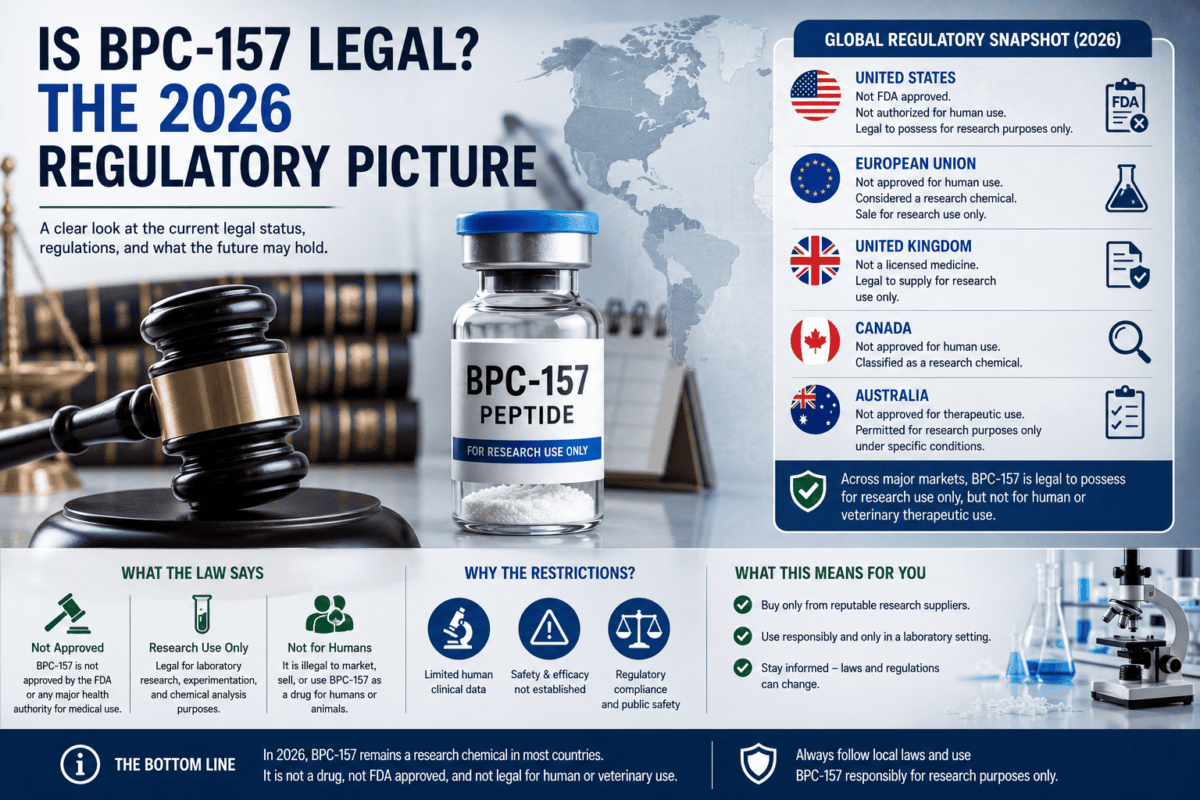
This question comes up constantly, and the answer has genuinely shifted this year, so it’s worth covering carefully.
BPC-157 has never received FDA approval as a drug, and as of 2026 there is still no FDA-registered human clinical trial or approved indication for it. In September 2023, the FDA placed BPC-157 on its “Category 2” compounding list, reflecting concern that human safety data was insufficient — a move that effectively blocked licensed compounding pharmacies from preparing it.
| Date | Regulatory Event |
|---|---|
| September 2023 | FDA places BPC-157 on Category 2 compounding list, citing insufficient human safety data |
| January 2022 | WADA temporarily bans BPC-157 for athletes (not currently on the active banned list) |
| February 27, 2026 | HHS Secretary announces ~14 of 19 restricted peptides, including BPC-157, are being considered for reclassification |
| April 22, 2026 | FDA formally removes BPC-157 from Category 2 (procedural, following nomination withdrawal) |
| July 23–24, 2026 | FDA’s Pharmacy Compounding Advisory Committee votes 8–6 to recommend BPC-157 for the 503A Bulks List |
| Ongoing (2026) | FDA has not issued a final rule; BPC-157 remains unapproved as a drug |
That changed procedurally in April 2026, when the FDA removed BPC-157 from Category 2 and scheduled it for review by the Pharmacy Compounding Advisory Committee. On July 23, 2026, that committee voted to recommend BPC-157 for inclusion on the FDA’s 503A “Bulks List” — the list that governs what licensed compounding pharmacies are legally allowed to prepare. You can review the FDA’s own meeting record directly on FDA.gov.
It’s important not to overstate what that vote means. A PCAC recommendation is not FDA approval, and it does not make BPC-157 an approved drug. The FDA still has to formally act on the recommendation, and even if it does, that governs compounding pharmacy access under a physician’s care — it doesn’t change the separate, more restrictive rules around research-chemical sales for personal use. Distributing an unapproved peptide for human use outside that regulated compounding pathway remains against federal law in 2026, regardless of how a product is labeled online.
The practical bottom line: BPC-157’s legal status is genuinely in flux right now, which is exactly why it’s not something to draw firm personal-use conclusions from based on any single blog post. Anyone considering it for a real health situation should be talking to a licensed physician who can speak to the current rules and their own specific medical circumstances.
BPC-157 vs. TB-500: How Do They Compare?
BPC-157 vs TB-500 is a common comparison among people researching experimental compounds for recovery. Both are peptides studied for tissue repair in animal models, but they’re structurally different and studied through somewhat different mechanisms.
| Feature | BPC-157 | TB-500 |
|---|---|---|
| Structure | 15-amino-acid pentadecapeptide | Fragment of thymosin beta-4 protein |
| Primary research focus | Tissue repair, GI healing, angiogenesis | Cell migration, actin regulation, wound healing |
| Volume of preclinical literature | Large, decades of studies | Smaller but growing |
| Human clinical trials completed | None | None |
| FDA approval status | Not approved | Not approved |
| 2026 compounding status | Recommended for Bulks List review (pending) | Also under PCAC review in July 2026 |
Neither has completed human clinical trials establishing efficacy, and neither is FDA-approved. In terms of “which has more research” — BPC-157 currently has a larger body of published preclinical literature, largely from research groups studying gastric protection and healing pathways, but larger doesn’t mean more clinically validated. Both compounds sit in a similar regulatory and evidentiary position: promising animal data, unresolved human evidence.
How Long Does BPC-157 Take to Work?
This is one of the most-searched questions about BPC-157, and it’s also one where the honest answer is: that specific timeline hasn’t been established in human clinical research. Any “days” or “weeks” figure circulating online is coming from anecdotal reports or extrapolation from animal dosing studies — not from controlled human trials that actually measured onset of effect. Treat specific timeframes you see quoted elsewhere with real skepticism.
Limitations of Current BPC-157 Research
Worth naming directly, since your own research deserves this context:
- Species gap — findings in rats and mice don’t automatically translate to humans
- Concentration of research groups — a large share of the published BPC-157 literature originates from a small number of research teams, which limits independent replication
- Dosing narrowness — many studies use a limited range of doses, leaving open questions about higher or repeated exposure
- No completed human efficacy trials — the single biggest gap between the online conversation and the actual state of the science
- Unregulated product quality — even setting aside efficacy questions, research-chemical sourcing means purity and dosing accuracy aren’t independently guaranteed the way an FDA-approved drug’s would be
The Bottom Line on BPC-157 Peptide Benefits
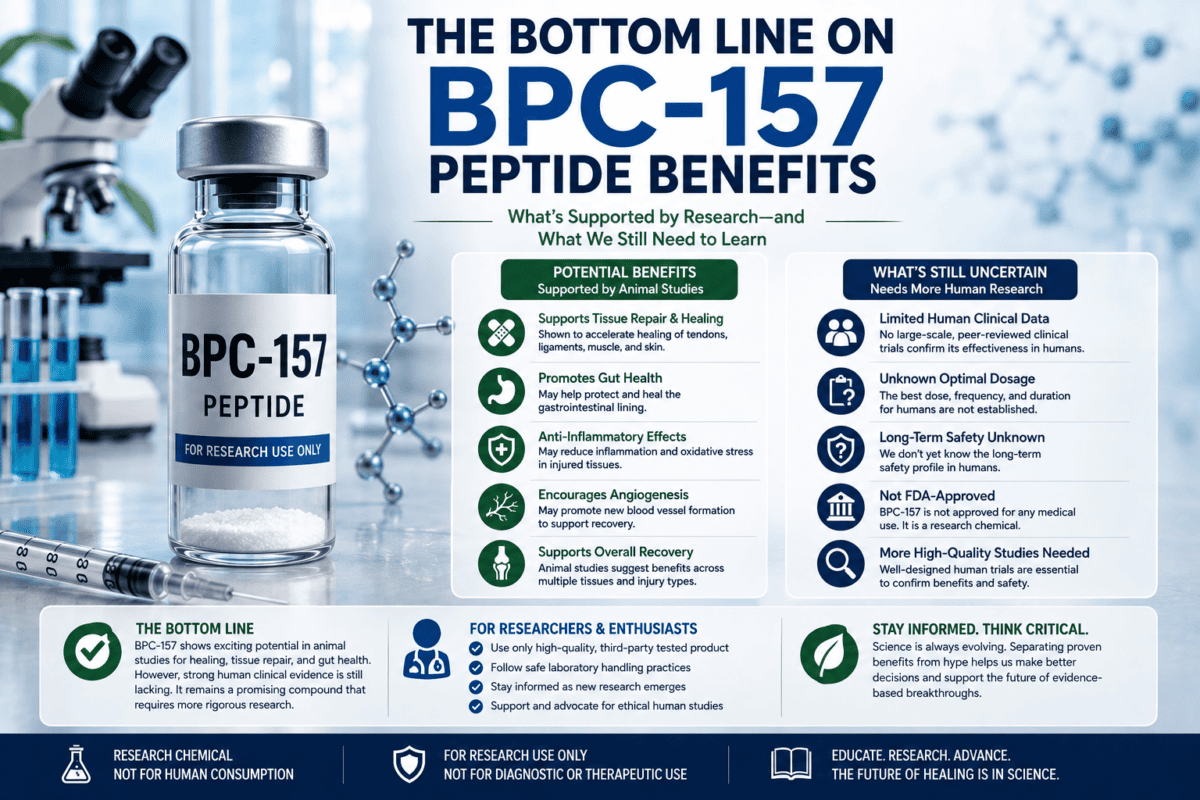
BPC-157 is a legitimately interesting subject of ongoing research. The preclinical picture — spanning tissue repair, tendon and ligament healing, muscle recovery, gut health, and inflammation — is more consistent than most experimental compounds ever manage to produce. That’s genuinely part of why the conversation around BPC-157 peptide benefits keeps growing among scientists, athletes, and wellness-focused readers alike.
But “consistently promising in animal models” and “proven to work in people” are two different claims, and right now, only the first one is backed by completed research. The regulatory landscape is actively evolving in 2026, human trials remain absent, and even within the scientific literature there’s open debate about safety questions that haven’t been fully resolved.
If you’re researching BPC-157 peptide benefits for a personal health decision rather than general interest, the most useful next step isn’t another blog post — it’s a conversation with a licensed physician who can walk you through where the science and the current legal landscape actually stand.
Frequently Asked Questions
What are the benefits of BPC-157? In animal and lab research, BPC-157 has been studied for potential effects on tendon, ligament, and muscle healing, gastrointestinal tissue repair, and inflammation reduction. These are research findings from preclinical models, not confirmed human clinical benefits.
What are the potential benefits of BPC-157 peptide? The potential benefits under investigation include faster tendon and ligament healing, improved gut lining repair, reduced inflammation, and support for muscle recovery after injury — all observed primarily in animal studies rather than confirmed in humans.
What is BPC-157 peptide used for? In research settings, it’s used to study tissue repair mechanisms, gastrointestinal protection, and inflammation pathways. It is not approved or labeled for any human therapeutic use.
What does BPC-157 peptide do? It’s studied for its apparent role in supporting tissue repair processes — including blood vessel formation, nitric oxide signaling, and modulation of inflammatory and growth-factor pathways — primarily in animal models.
How does BPC-157 work in the body? Proposed mechanisms include promoting angiogenesis, modulating nitric oxide signaling, and influencing growth factor and inflammatory pathways, though the complete mechanism isn’t fully mapped in human physiology.
Is BPC-157 effective for healing? Preclinical evidence is consistently positive across several tissue types, but effectiveness in humans hasn’t been established through completed clinical trials.
What does the research say about BPC-157 benefits? It says the preclinical case is strong and consistent, while the human clinical case is still essentially unwritten — a distinction that matters enormously when evaluating any specific claim.
Are BPC-157 peptide benefits proven in humans? No. No completed, large-scale human clinical trials currently establish BPC-157’s efficacy for any condition.
Can BPC-157 help with muscle recovery, tendon healing, or ligament injuries? Animal studies suggest it may support these processes, but human clinical evidence confirming this is not currently available.
Does BPC-157 help gut health or gastrointestinal healing? This is one of its most-studied areas in animal research, given its origin in gastric protective proteins, but human trials are still lacking.
Does BPC-157 reduce inflammation? Animal studies report reduced inflammatory markers in various injury and GI models, though this hasn’t been confirmed through human clinical research.
Is BPC-157 FDA approved or legal for human use? No. It is not FDA-approved. Its compounding status has shifted in 2026 (removed from Category 2, recommended for the Bulks List by an FDA advisory committee in July 2026), but that process is not complete, and distributing it for human use outside regulated pathways remains against federal law.
Is BPC-157 safe? Formal human safety data is limited. Animal studies generally report a favorable short-term safety profile, but long-term human safety hasn’t been established, and there’s active scientific debate about certain safety questions.