Peptide Research
KLOW vs GLOW Peptide: Ingredients, Uses & Benefits Compared
What Is the Difference Between KLOW and GLOW Peptide? A Complete Comparison of Ingredients, Uses, and Benefits
What is the difference between KLOW and GLOW peptide? It’s the first thing most newcomers try to untangle when they start researching peptide blends — and it’s a fair question, because the two names get used almost interchangeably in skincare and wellness forums. KLOW and GLOW peptide sound similar. They’re often talked about in the same breath. And if you’re new to this space, it’s easy to assume they’re basically the same thing with different labels.
They’re not.
It comes down to what’s actually inside each blend, what those individual peptides are believed to do, and how manufacturers position them for different goals — one leaning toward skin-focused outcomes, the other toward broader recovery and vitality support. Once you break down the ingredient lists side by side, the picture becomes a lot clearer.
This guide walks through what is KLOW peptide, what is GLOW peptide, how their formulas compare, what the research does and doesn’t say, and the questions people ask most often before choosing between the two.
A quick note before we dive in: peptide blends like these are typically sold for research purposes, and formulations can vary meaningfully from one manufacturer to the next. Nothing in this article should be read as medical advice or as a recommendation to use these products in a specific way — if you’re considering them, that conversation belongs with a licensed healthcare provider who can look at your specific situation.
What Is the Difference Between KLOW and GLOW Peptide? A Quick Overview
Before we get into the weeds, here’s the short version of what is the difference between KLOW and GLOW peptide.
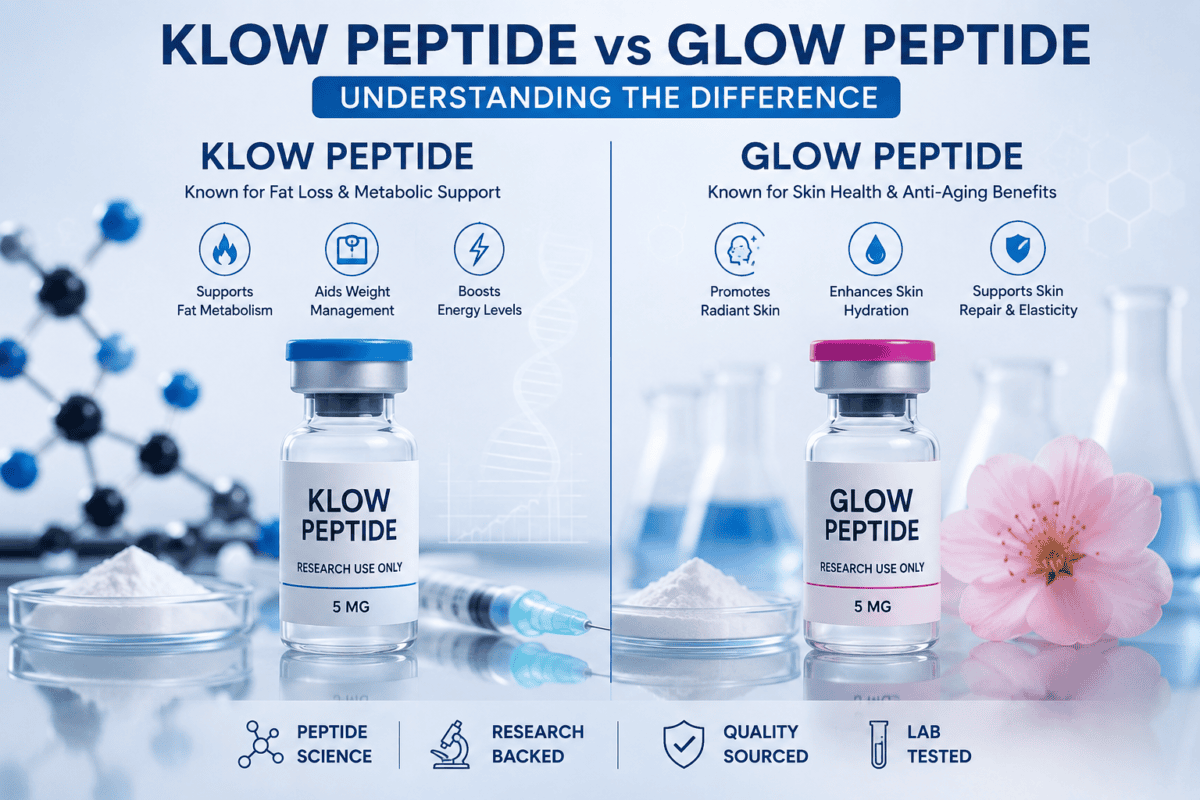
KLOW is a peptide blend that’s most commonly associated with skin-focused ingredients — think tissue support, collagen-related activity, and recovery at the skin level. It’s often discussed in the context of KLOW peptide for skin, anti-aging conversations, and topical or research applications tied to appearance.
GLOW peptide tends to be framed a bit more broadly. While it shares some ingredient overlap with KLOW, it’s frequently discussed alongside goals like general vitality, tissue repair, and whole-body wellness rather than skin outcomes alone.
Neither name refers to a single, standardized, universally regulated formula. That’s an important point we’ll come back to throughout this piece — because it changes how you should answer what is the difference between KLOW and GLOW peptide for any product carrying either label.
What Is KLOW Peptide?
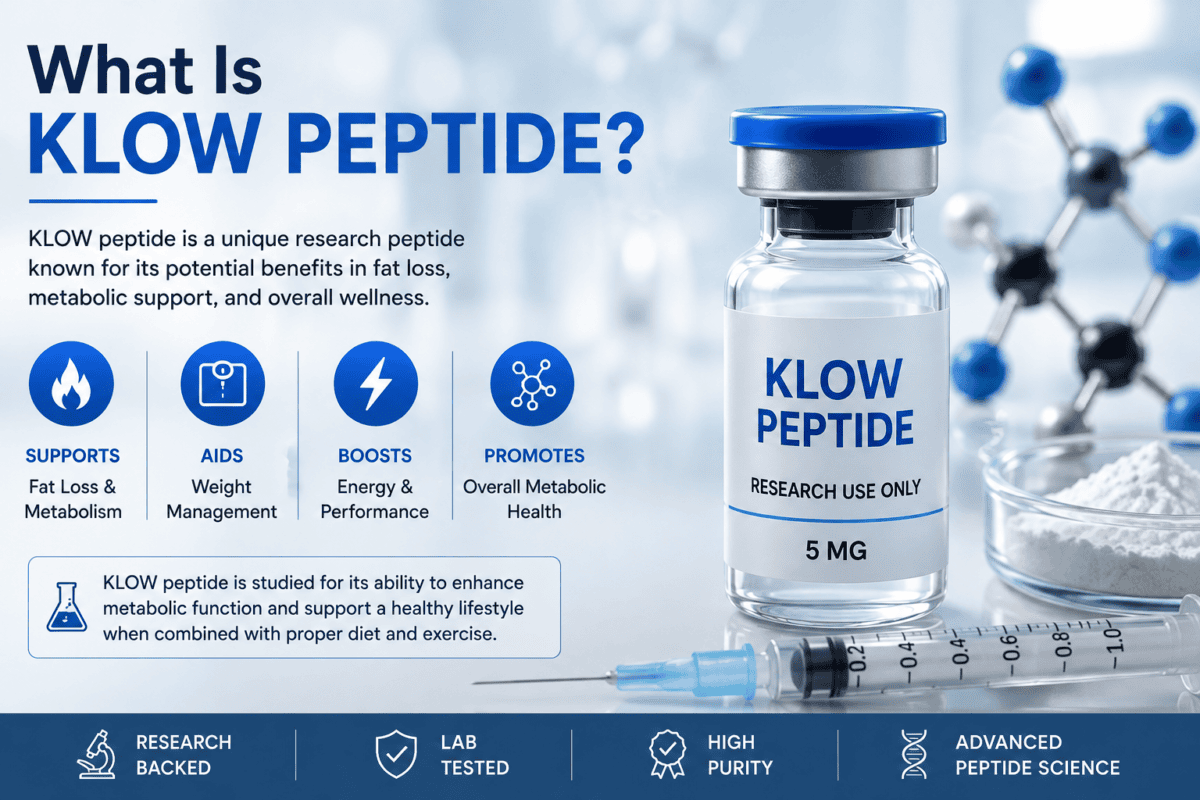
KLOW is typically described as a peptide blend — meaning it’s not one single peptide, but a combination of several, each contributing something different to the overall formula. Understanding what’s in KLOW is the first half of answering what is the difference between KLOW and GLOW peptide. The name itself is often used as shorthand by manufacturers and communities to describe a stack rather than one isolated molecule.
KLOW Peptide Ingredients
While exact KLOW peptide formula details can vary by supplier, the blend is most commonly discussed as including some combination of:
- GHK-Cu (Copper Peptide) — a naturally occurring copper-binding peptide studied for its role in tissue remodeling and collagen-related activity in published skin-regeneration research.
- KPV — a tripeptide often discussed in the context of skin and tissue support in preclinical research, including foundational anti-inflammatory studies published in Gastroenterology.
- TB-500 (Thymosin Beta-4 fragment) — frequently referenced in discussions of tissue repair and recovery.
- Organic GHK or related copper-peptide derivatives — sometimes layered in to reinforce the skin-focused angle of the blend.
Because KLOW peptide ingredients are combined rather than sold individually, the appeal is convenience: instead of researching and sourcing four separate compounds, users interested in this category get one blended product.
What Can KLOW Help With?
This is one of the most common questions people ask, and it deserves a careful answer. In early-stage and preclinical research, the individual components of KLOW have been studied for things like:
- Skin tissue support and collagen-related activity
- Recovery-related processes at the cellular level
- General tissue remodeling in laboratory and animal models
It’s important to separate that research from marketing claims about the finished KLOW blend itself — a distinction that’s central to answering what is the difference between KLOW and GLOW peptide. Most of the evidence exists for the individual peptides studied in isolation — not necessarily for this specific combination, dosage, or delivery method. When a product page says a blend “supports glowing skin” or “accelerates recovery,” that’s a claim built on the reputation of the ingredients, not necessarily on trials of the finished product.
What Is GLOW Peptide?
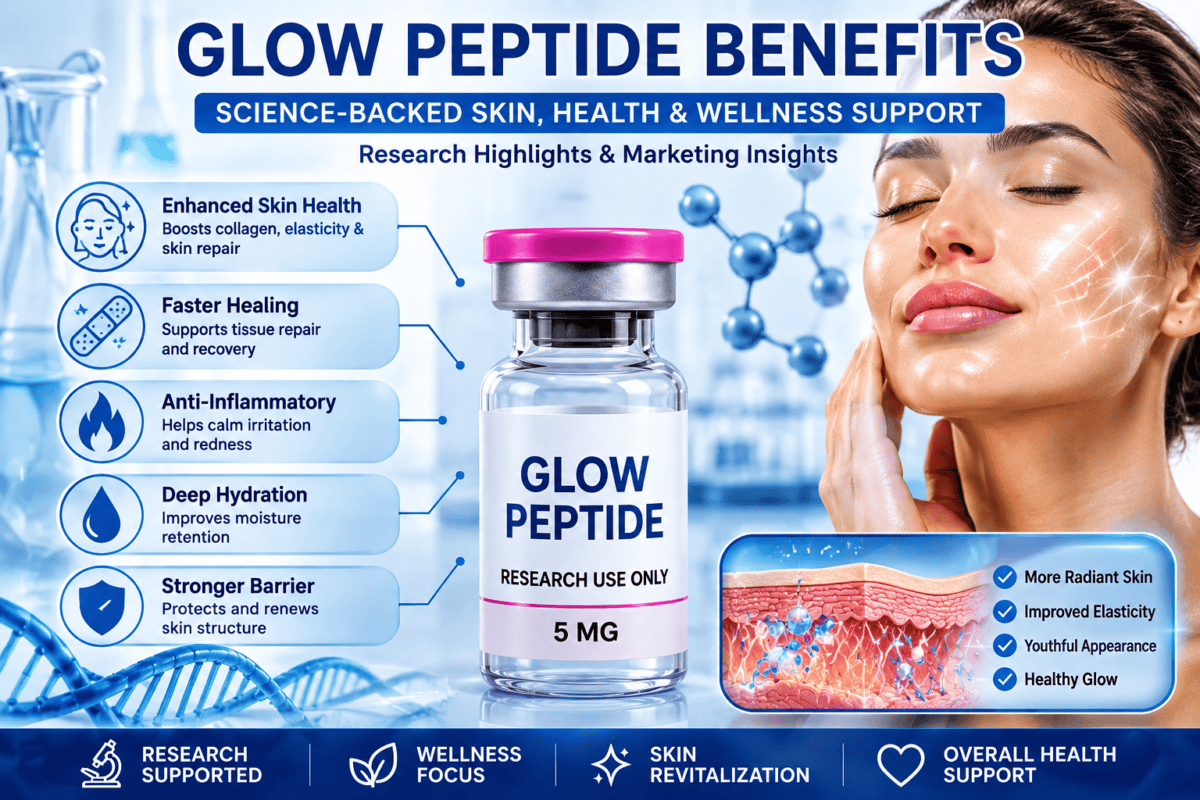
GLOW peptide is the second half of this comparison, and it’s often positioned as a companion or alternative to KLOW rather than a direct substitute. Now that we’ve covered KLOW, GLOW is the other piece needed to fully answer what is the difference between KLOW and GLOW peptide.
GLOW Peptide Ingredients
GLOW peptide ingredients commonly discussed in this category include:
- GHK-Cu — again, a shared ingredient with KLOW, which is part of why the two get compared so often.
- BPC-157 — one of the most widely discussed peptides in the recovery and wellness research space, studied preclinically for its role in tissue and gut-lining research models, including a recent systematic review of the musculoskeletal literature.
- TB-500 — also shared with KLOW in many formulations, tying the two blends together on the recovery side.
- Additional co-factors or supporting peptides, depending on the manufacturer’s GLOW peptide formula.
GLOW Peptide Benefits (As Discussed in Research and Marketing)
Much like KLOW, the benefits associated with GLOW are drawn primarily from studies on its individual components rather than the combined product. Topics that come up frequently include:
- Tissue and recovery-related research
- General wellness and vitality framing
- Overlap with longevity-adjacent research conversations
Again, the honest caveat matters here — and it applies to what is the difference between KLOW and GLOW peptide broadly: GLOW peptide benefits as marketed and GLOW peptide benefits as demonstrated in controlled human trials of the finished blend are two different things. Reputable sources will make that distinction clear; less careful marketing sometimes blurs it.
What Is the Difference Between KLOW and GLOW Peptide? Side-by-Side Comparison
Here’s where the answer to what is the difference between KLOW and GLOW peptide gets useful to see in practice. Laid out side by side, the KLOW GLOW peptide differences become much easier to see.
Ingredient Focus
| Aspect | KLOW | GLOW |
|---|---|---|
| Primary framing | Skin and tissue-focused | Recovery and vitality-focused |
| Shared ingredients | GHK-Cu, TB-500 (common) | GHK-Cu, TB-500 (common) |
| Distinguishing ingredient | KPV (skin/tissue emphasis) | BPC-157 (recovery emphasis) |
| Common association | KLOW peptide for skin | Broader wellness support |
Positioning and Intended Use
Think of it this way: if KLOW is the blend built around a skin-and-appearance narrative, GLOW is the blend built around a recovery-and-resilience narrative. They overlap in the middle — largely because GHK-Cu and TB-500 show up in both — but they diverge at the edges based on which additional peptide rounds out the formula.
This is a useful mental model, but it’s also a simplification of what is the difference between KLOW and GLOW peptide. Because there’s no single regulatory body standardizing what “KLOW” or “GLOW” must contain, are KLOW and GLOW peptides the same is actually a harder question to answer definitively than it should be. Two products both labeled “GLOW” from two different manufacturers could have meaningfully different ratios, purity levels, or even different supporting ingredients entirely.
KLOW vs GLOW Peptide Benefits
When people ask about KLOW vs GLOW peptide benefits, they’re usually really asking a version of what is the difference between KLOW and GLOW peptide: “which one is designed for what I care about?”
- If skin appearance, collagen-related research, and tissue-level skin support are the priority, KLOW’s ingredient list leans that direction.
- If general recovery, tissue repair research, and broader wellness framing are the priority, GLOW’s ingredient list leans that direction.
Neither is inherently “stronger” or “better” in a clinical sense — they’re built around different research narratives, using overlapping but distinct peptide combinations.
Is GLOW or KLOW Better?
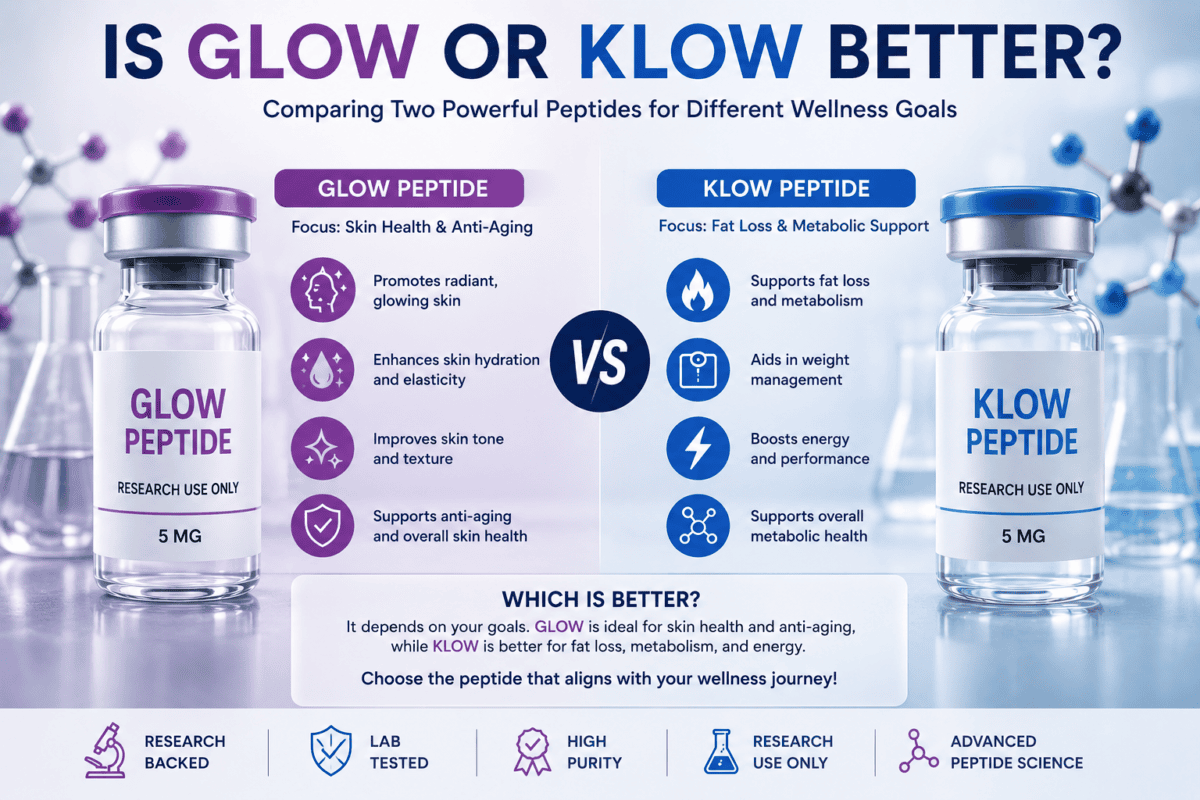
This is one of the most frequently asked questions in this space, and the honest answer is: it depends entirely on what you’re evaluating it for, and it’s not a question with strong head-to-head clinical evidence behind it — much like what is the difference between KLOW and GLOW peptide more broadly, it resists a single simple ranking.
There are no large-scale, peer-reviewed human trials directly comparing a finished KLOW blend against a finished GLOW blend. What exists is research on the individual peptides — GHK-Cu, BPC-157, TB-500, KPV — largely from preclinical, animal, or early-stage studies. Extrapolating “KLOW is better for skin” or “GLOW is better for recovery” from ingredient-level research to product-level outcomes is a leap that marketing copy makes far more confidently than the underlying science supports.
A more accurate way to frame it: KLOW vs GLOW which is better really translates to “which ingredient profile is better studied for the outcome I’m interested in” — and that’s a question worth researching ingredient-by-ingredient rather than brand-by-brand.
Formulation Differences That Matter
Beyond the headline ingredients, a few formulation factors separate one manufacturer’s version of KLOW or GLOW from another’s — and these factors matter as much to what is the difference between KLOW and GLOW peptide as the ingredient lists themselves:
Concentration and ratio. Even when two products share the same named ingredients, the ratio between them can shift the character of the blend significantly.
Purity and testing. Third-party purity testing (often reported via HPLC or mass spectrometry) is one of the clearest ways to differentiate a rigorously manufactured product from one that isn’t. Not every manufacturer publishes this data, and that absence is itself worth noting when evaluating a product.
Carrier and stabilization. How a peptide blend is stabilized, and whether it requires specific storage conditions, can affect its integrity over time — which matters more than most buyers initially realize.
Sourcing transparency. Manufacturers who clearly disclose sourcing, batch testing, and third-party verification tend to be easier to evaluate critically than those who rely primarily on testimonial-driven marketing.
What Is the Difference Between KLOW and GLOW Peptide Ingredients? The Research Behind Them
To really answer what is the difference between KLOW and GLOW peptide, it helps to zoom in on the individual ingredients that show up across both blends, since the finished-product claims trace back to research on these compounds:
GHK-Cu (Copper Peptide) has one of the longer research histories in this group, with published studies going back decades — much of it centered on skin and wound-healing models. It’s the connective thread between KLOW and GLOW, and part of why both blends get grouped into “glow” and “recovery” conversations at once.
BPC-157, GLOW’s signature addition, has generated significant interest in the wellness and research community, largely from animal studies examining tissue and gut-related outcomes. Human clinical trial data remains limited, which is a gap worth being upfront about rather than glossing over.
TB-500 (a synthetic fragment related to Thymosin Beta-4) shows up in both blends and has research history tied to cellular migration and tissue-related processes in laboratory models, mapped in detail in a recent scoping review of the TB-500 literature.
KPV, KLOW’s more distinguishing ingredient, has been researched in the context of skin and inflammatory response models, though — like the others — primarily at the preclinical stage.
The throughline across all four — and across what is the difference between KLOW and GLOW peptide as a whole: interesting, evolving research at the ingredient level, but a real gap between “here’s what a compound does in a lab model” and “here’s what a commercial blend does in a person,” a gap that responsible sourcing should acknowledge rather than paper over with confident marketing language.
Addressing the Common Questions
A number of frequently asked questions come up around what is the difference between KLOW and GLOW peptide that deserve a direct, honest answer rather than a vague one.
Can you take GLOW and KLOW together? Because the two blends share overlapping ingredients (notably GHK-Cu and TB-500), combining them isn’t as simple as “stacking two different products” — you’d effectively be layering overlapping compounds, which changes the overall exposure profile in ways that aren’t well studied. This is exactly the kind of question that needs a conversation with a licensed healthcare provider who understands your specific situation, rather than a generic yes-or-no answer.
Does GLOW have side effects? Why does KLOW peptide burn? Individual components of these blends have documented tolerability considerations in the research literature, and injection-site reactions (including a burning or stinging sensation) are commonly reported anecdotally with copper-peptide and similar compounds. Because formulations vary by manufacturer, so does the tolerability profile — which is precisely why generic answers aren’t reliable, and why anyone experiencing an adverse reaction should stop and consult a healthcare professional rather than troubleshoot it themselves.
How long does it take for KLOW or GLOW to work? What are the results of KLOW skin treatment? Timelines and outcomes cited online are almost entirely anecdotal or drawn from marketing material rather than controlled trials of the finished blends. Anyone evaluating a realistic timeline should treat online testimonials as anecdotes, not evidence, and again, this is a question best directed to a qualified provider.
Where to inject KLOW or GLOW peptide? How to mix KLOW? How often do you take it? Morning or night? These are administration-specific questions, and they don’t have a single correct answer that applies across products, manufacturers, or individuals — the right approach depends on the specific formulation, concentration, and a person’s individual health profile. This is not something to piece together from forum posts or blog articles, including this one. It’s a conversation for a licensed healthcare provider or the guidance explicitly provided by the manufacturer for their specific product.
Which GLOW peptide is the best? Is it best to take GLOW in the morning or at night? “Best” depends on manufacturing quality, transparency, and — again — individual goals and health status, not a universal ranking. Anyone weighing this decision is better served comparing manufacturer transparency and third-party testing than chasing a single “best” answer.
Important Considerations Before Comparing Products
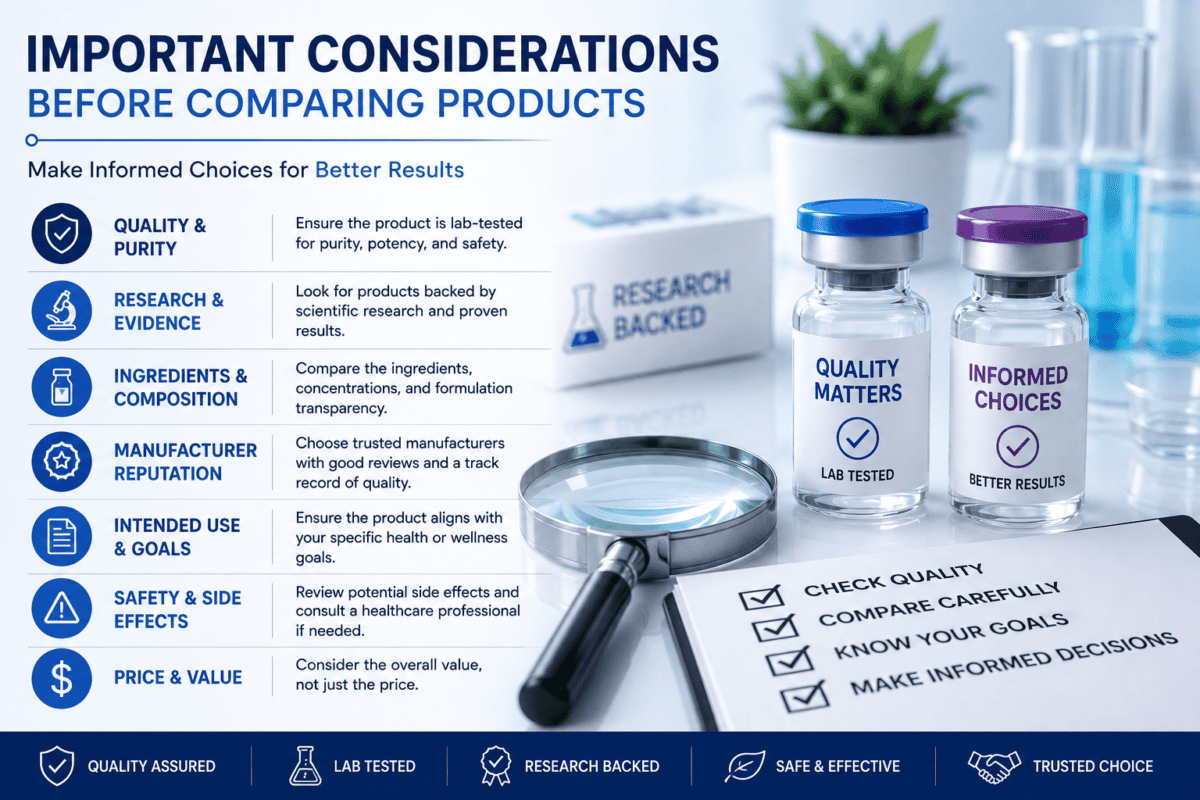
A few things are worth keeping in mind no matter which side of what is the difference between KLOW and GLOW peptide you’re researching:
Names aren’t standardized. “KLOW” and “GLOW” function more like category names or brand shorthand than fixed, regulated formulas, which is part of what makes what is the difference between KLOW and GLOW peptide hard to pin down in general terms. Always check the actual ingredient list and concentrations for the specific product you’re looking at, rather than assuming the name guarantees a fixed formula.
Marketing claims and research findings are not the same thing. A lot of the language used to sell these blends borrows credibility from studies on individual peptides, even when the finished product hasn’t been tested the same way.
Manufacturer transparency is a strong signal. Third-party testing, clear sourcing information, and honest labeling separate credible suppliers from ones relying on hype. It’s also worth knowing that several of these ingredients are currently under active review by the FDA’s Pharmacy Compounding Advisory Committee, which regularly reassesses which peptides may legally be used in compounding — a status that can change.
This is a research-focused category. Much of the available literature on GHK-Cu, BPC-157, TB-500, and KPV comes from preclinical or animal research, not large human trials — a limitation that applies to both sides of what is the difference between KLOW and GLOW peptide equally. That doesn’t make the research uninteresting — it just means claims should be read with that context in mind.
What Is the Difference Between KLOW and GLOW Peptide? Final Thoughts
So, what is the difference between KLOW and GLOW peptide? At the ingredient level, it comes down to emphasis: KLOW leans toward skin-and-tissue-focused peptides like KPV alongside GHK-Cu, while GLOW leans toward recovery-focused peptides like BPC-157 alongside the same GHK-Cu backbone. Both share TB-500 in many formulations, which is part of why the two get compared so often in the first place.
Neither blend is a magic formula, and neither is inherently superior — they’re built around different research narratives using overlapping ingredient sets. The most useful thing you can do as a researcher or consumer is look past the name on the label and evaluate the actual ingredient list, the sourcing transparency, and the strength of the evidence behind each component.
And for anything involving actual use — dosing, administration, timing, or combining products — that decision belongs with a licensed healthcare provider, not a blog post or a product page. That’s the honest, full answer to what is the difference between KLOW and GLOW peptide.