Peptide Research
Benefits of Ipamorelin: Evidence, Uses & Safety
Benefits of Ipamorelin: What the Research Actually Says About This Growth Hormone Peptide
If you’ve spent any time in wellness or biohacking circles lately, you’ve probably heard someone mention ipamorelin. It comes up in conversations about muscle recovery, sleep quality, body composition, and “anti-aging” protocols — usually alongside a lot of confident claims about the benefits of ipamorelin.
Here’s the problem: most of what circulates online about the benefits of ipamorelin blends real pharmacology with marketing language, and the two are easy to mix up if you’re not looking closely.
This guide is meant to pull those threads apart. We’ll walk through what ipamorelin actually is, how it works in the body, what the research — not the sales copy — has found about the potential benefits of ipamorelin, and where the real uncertainties and limitations sit. By the end, you should be equipped to have an informed conversation with a healthcare provider, rather than relying on forum threads or product pages promising exaggerated ipamorelin benefits.
One thing worth stating up front: ipamorelin is not an FDA-approved medication, and nothing in this article should be read as medical advice or a recommendation to use it (FDA, Certain Bulk Drug Substances for Use in Compounding). Think of this as the primer you’d want before that conversation, not a substitute for it.
What Is Ipamorelin Peptide?
So, what is ipamorelin peptide, exactly? Chemically, it’s a small chain of five amino acids — a pentapeptide — that belongs to a class of compounds called growth hormone-releasing peptides (GHRPs), also known as growth hormone secretagogues.
It was first described in the late 1990s by researchers looking for a way to stimulate the body’s own growth hormone (GH) production without some of the unwanted side effects seen in earlier compounds of the same class. That original research, led by Raun and colleagues in 1998 and published in the European Journal of Endocrinology, found that ipamorelin triggered GH release in animal models while leaving other hormones largely untouched (Raun et al., 1998, PubMed).
That selectivity is the single most-cited feature of ipamorelin in the scientific literature, and it’s the thread that runs through almost every discussion of the benefits of ipamorelin you’ll find in research summaries.
How Does Ipamorelin Work?
To understand how does ipamorelin work, it helps to picture the body’s natural hunger-and-growth signaling system.
Your body produces a hormone called ghrelin — often nicknamed the “hunger hormone” — which does double duty. Beyond stimulating appetite, ghrelin also binds to a receptor called GHS-R1a (the growth hormone secretagogue receptor) on cells in the pituitary gland, prompting a pulse of growth hormone release. The discovery of ghrelin itself, by Kojima and colleagues, was published in Nature in 1999 (Kojima et al., 1999, Nature).
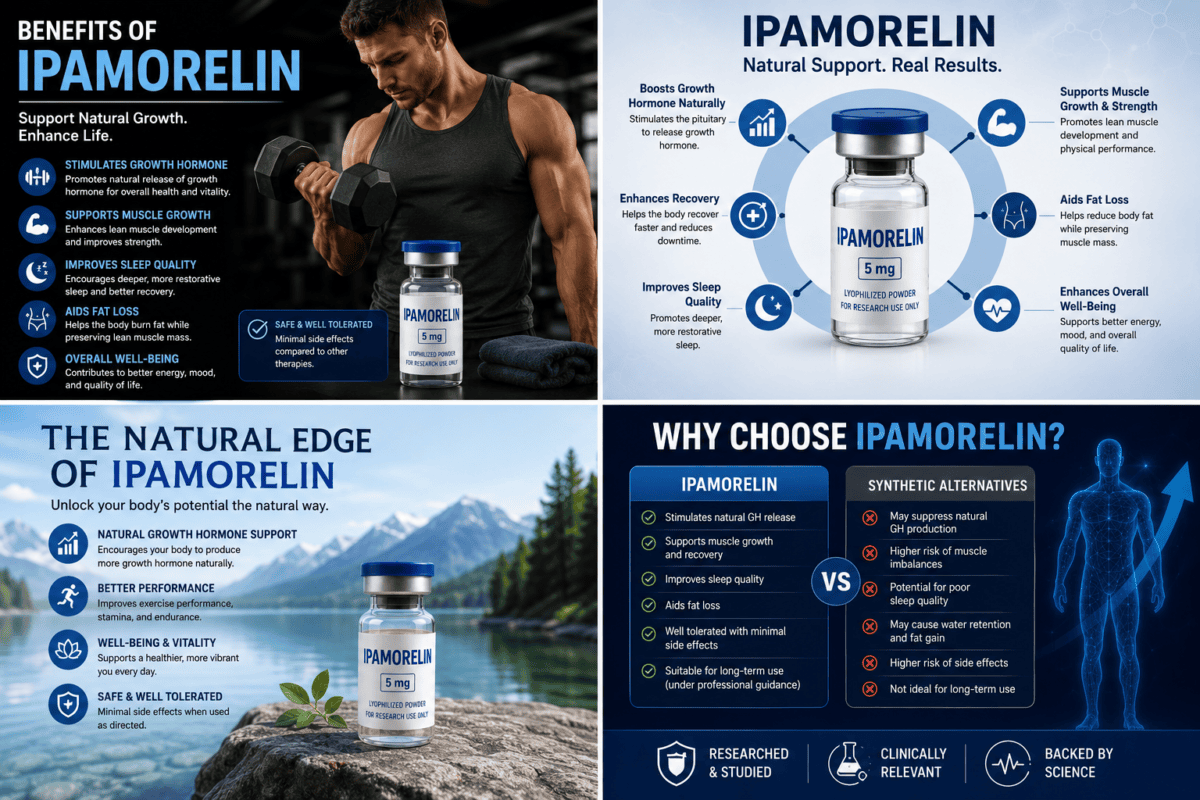
Ipamorelin and growth hormone are connected through this exact pathway. Ipamorelin is designed to mimic ghrelin at that same receptor, essentially knocking on the same door. When it binds, it triggers the pituitary to release GH that’s already stored and ready to go, in the body’s natural pulsatile rhythm — rather than a slow drip or a flat, sustained elevation.
What makes ipamorelin stand out among growth hormone secretagogues is its selectivity. Earlier compounds in this family, like GHRP-6, tend to also nudge up cortisol (the stress hormone) and prolactin when they stimulate GH release. In controlled animal studies, ipamorelin didn’t produce that same spillover — even at doses far higher than what was needed to trigger GH release (Raun et al., 1998, PubMed). That’s the mechanistic basis for most of the interest in the benefits of ipamorelin, and it’s worth sitting with, because it’s also where the evidence is strongest and best understood.
Ipamorelin Peptide Effects: What Research Has Actually Examined
This is where it’s important to slow down. A lot of content about ipamorelin peptide effects jumps straight from “this is the mechanism” to “here’s what it does for your body,” without acknowledging the size of that leap. Let’s look at what’s actually been studied when people search for ipamorelin research benefits.
Preclinical and Animal Research
The bulk of the evidence base for the proposed benefits of ipamorelin comes from animal studies — primarily in pigs and rodents. These studies established the core findings that everything else builds on:
- Ipamorelin reliably stimulates GH release in a dose-dependent way
- It does so without significantly raising ACTH, cortisol, or prolactin, unlike some related peptides
- It doesn’t appear to disrupt other pituitary hormones like FSH, LH, or TSH in these models
This is genuinely useful groundwork (Raun et al., 1998, PubMed). But animal pharmacology doesn’t automatically translate into predictable human outcomes, especially for anything beyond the immediate hormonal response.
Human Studies
Human data on ipamorelin is much thinner than the marketing landscape suggests, which matters if you’re weighing the ipamorelin benefits and side effects described online. A small number of pharmacokinetic and pharmacodynamic studies in healthy volunteers confirmed that ipamorelin is rapidly absorbed and produces a measurable, short-lived spike in circulating GH, consistent with the animal findings (ClinicalTrials.gov search: Ipamorelin).
Ipamorelin’s most notable human clinical program targeted postoperative ileus — a condition where gut motility temporarily shuts down after abdominal surgery — leveraging ghrelin receptor activation’s effect on gastrointestinal motility rather than its GH-related effects. That Phase II trial (registered as NCT01023516) ultimately did not proceed to further development (ClinicalTrials.gov, NCT01023516). There is currently no completed, published human efficacy trial demonstrating the muscle mass, fat loss, skin quality, or sleep-related benefits of ipamorelin in the way marketing materials often imply.
That gap between mechanism and confirmed human outcome is the single most important thing to understand about this peptide’s current evidence base.
Exploring the Proposed Benefits of Ipamorelin
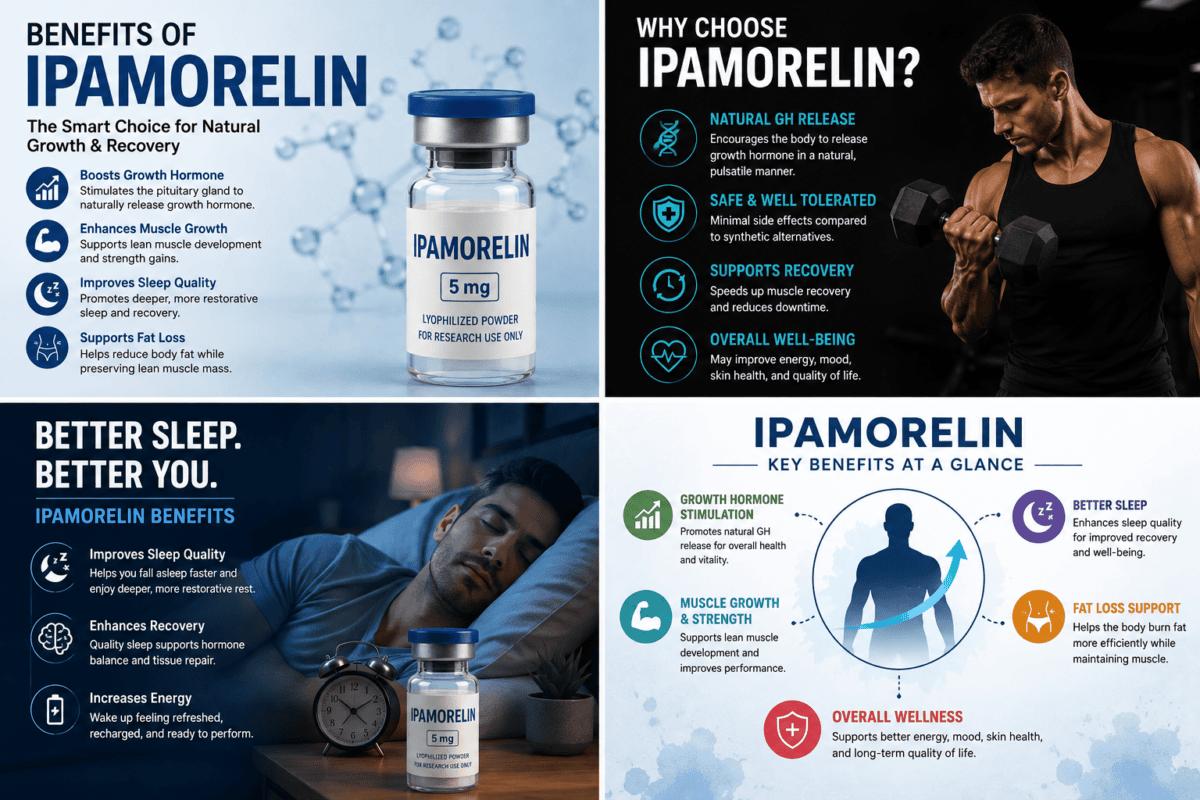
With that context in place, let’s walk through the areas where the benefits of ipamorelin are most often discussed — while being clear about what’s mechanistic plausibility versus confirmed effect.
Ipamorelin Benefits for Muscle Growth
The interest in ipamorelin benefits for muscle growth stems from GH’s known downstream role in stimulating IGF-1 production in the liver, which in turn supports protein synthesis and muscle tissue maintenance. This is well-established physiology for growth hormone itself (NIH, Growth Hormone and IGF-1 overview).
What hasn’t been directly demonstrated in controlled human trials is that ipamorelin-induced GH pulses translate into meaningfully greater muscle mass or strength compared to baseline. The reasoning is plausible; the direct proof, in humans, specifically for ipamorelin, isn’t there yet.
Ipamorelin Benefits for Recovery
Similarly, claims around ipamorelin benefits for recovery rest on GH and IGF-1’s documented roles in tissue repair and sleep-related restorative processes. Athletes and researchers are naturally curious whether amplifying natural GH pulses could support faster recovery between training sessions — one of the more common ipamorelin benefits for athletes cited informally.
Again — plausible mechanism, but this specific outcome hasn’t been isolated and confirmed in ipamorelin-specific human research.
Ipamorelin Benefits for Sleep
Ipamorelin benefits for sleep get discussed frequently because GH release naturally peaks during deep, slow-wave sleep, and the two systems are physiologically intertwined (Van Cauter et al., sleep and GH secretion, PubMed). Some anecdotal reports describe improved sleep quality with GH secretagogue use generally.
However, the relationship between GH secretagogues and sleep architecture is complex — it’s not simply “more GH equals better sleep” — and rigorous, controlled human data specific to the sleep-related benefits of ipamorelin is limited.
Ipamorelin Benefits for Fat Loss
Is ipamorelin a fat burner? This is one of the most common questions, and the honest answer is: not in any established or approved sense. GH does play a role in lipolysis (fat breakdown) in general endocrinology, which is the basis for this line of speculation. But “GH is involved in fat metabolism” is a long way from confirming the fat-loss benefits of ipamorelin in humans — a claim that hasn’t been substantiated by controlled trials for this peptide specifically.
Ipamorelin Benefits for Skin
Questions about ipamorelin benefits for skin — including whether it can make someone “look younger” — generally trace back to GH and IGF-1’s roles in collagen synthesis, which are documented in broader endocrinology research. There is no direct, controlled human research demonstrating that ipamorelin use produces visible skin changes. This remains one of the more speculative extensions of the mechanism, several steps removed from anything that’s been tested.
Ipamorelin and Body Composition
Broader claims about ipamorelin and body composition — the combined idea of more muscle and less fat — follow the same pattern as the individual claims above: grounded in general GH physiology, not yet demonstrated through dedicated human trials of ipamorelin itself.
Ipamorelin Growth Hormone Benefits Compared to Other Peptides
People researching this space often want to know how the ipamorelin growth hormone benefits compare to other options in the same general category.
Ipamorelin vs. Sermorelin: These work through different receptors entirely. Ipamorelin activates the ghrelin receptor (GHS-R1a); sermorelin is a GHRH analog that works through the separate GHRH receptor pathway. Because they act on different points in the GH-release cascade, some researchers have explored combining GHRH analogs with GHRPs like ipamorelin, theorizing a complementary effect — though this, too, is an area of ongoing investigation rather than settled human outcome data.
Ipamorelin vs. GHRP-2 / GHRP-6: All three are ghrelin receptor agonists, but ipamorelin’s defining feature in animal studies is that it doesn’t meaningfully raise cortisol or prolactin the way GHRP-2 and GHRP-6 have been shown to (Arvat et al., 1997, comparative GHRP study). That’s the main mechanistic distinction researchers point to when discussing ipamorelin growth hormone secretagogue selectivity, and it’s central to how the benefits of ipamorelin get framed relative to older peptides in its class.
If you’re wondering what is the strongest peptide for muscle growth, it’s worth knowing that “strongest” isn’t really a scientifically meaningful category here — different secretagogues have different receptor selectivity, hormonal side-effect profiles, and (crucially) different levels of human evidence behind them. None of the peptides in this class currently carry FDA approval for muscle-building indications.
Ipamorelin Safety and Side Effects
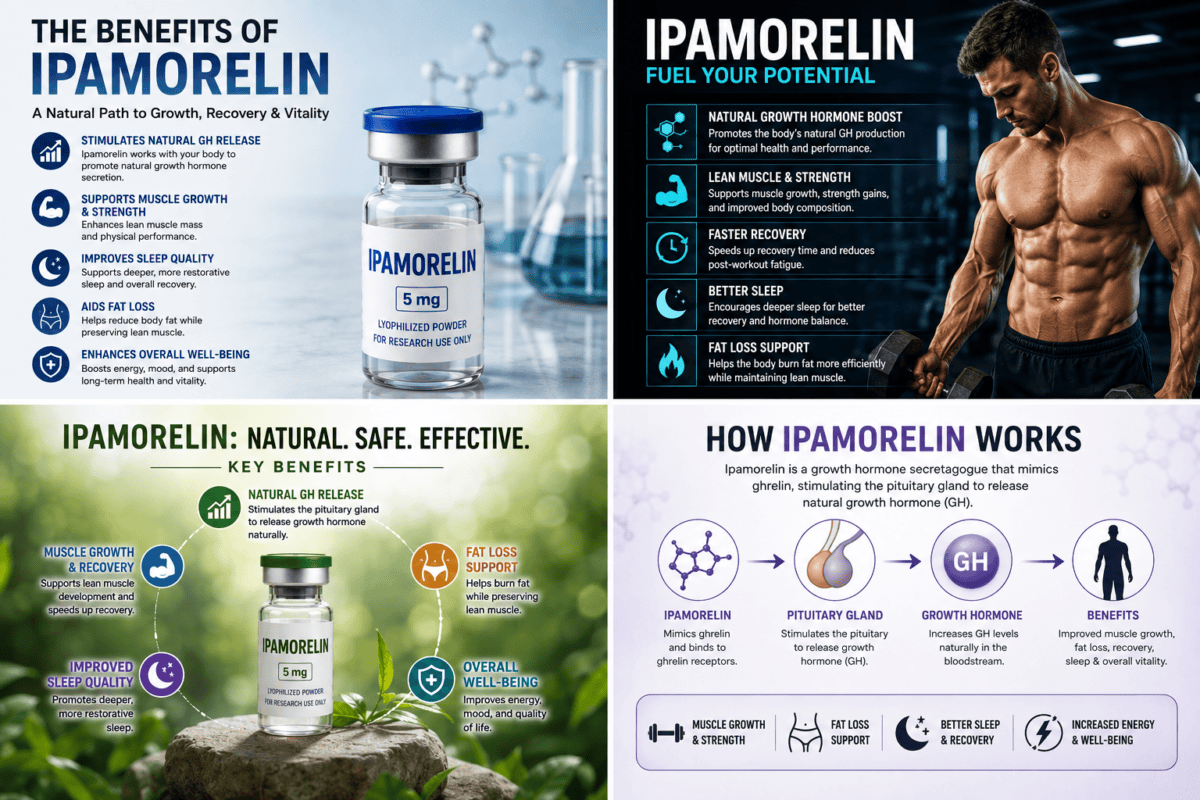
Understanding ipamorelin safety and side effects starts with separating two different questions: what does the pharmacology suggest, and what does the regulatory and manufacturing landscape look like?
On the pharmacology side, the animal and limited human PK data suggest a relatively narrow hormonal footprint compared to older GHRPs — that’s the whole basis for calling ipamorelin “selective.” But a narrow hormonal footprint in short-term studies is not the same as a well-characterized long-term safety profile in humans.
There is currently no robust body of long term effects of ipamorelin research in humans to draw on. Chronic secretagogue use, in general endocrinology, raises open questions about receptor sensitivity, insulin signaling, and sustained GH/IGF-1 elevation that haven’t been specifically resolved for ipamorelin.
On the regulatory and supply side, the concerns are more immediate. The FDA has publicly flagged that compounded peptides in this category may carry immunogenicity and impurity-related risks, and that limited safety data exists for many proposed routes of administration (FDA, Certain Bulk Drug Substances for Use in Compounding). Ipamorelin sold through online research-chemical vendors is not manufactured under pharmaceutical oversight.
Independent testing of gray-market peptide products has repeatedly found issues with purity, incorrect concentration, and even misidentified compounds. That’s a real, practical safety consideration entirely separate from the pharmacology question — a compound in a vial isn’t guaranteed to be what the label says it is.
Is Ipamorelin FDA Approved? Ipamorelin Clinical Research and Regulatory Status
This question — is ipamorelin FDA approved — deserves a direct, unambiguous answer: no. Ipamorelin has never received FDA approval for any indication, in the United States or comparable regulatory bodies elsewhere, including the European Medicines Agency.
The regulatory picture has also shifted in recent years, which is worth knowing if you’re evaluating ipamorelin clinical research and its compounding status. In September 2023, the FDA placed ipamorelin acetate in Category 2 of its interim 503A bulks list — the category reserved for substances the agency considers to raise significant safety risks for compounding (FDA, Certain Bulk Drug Substances for Use in Compounding).
In September 2024, ipamorelin acetate was removed from Category 2 after its nominator withdrew the nomination, and the FDA indicated it would be reviewed again through its formal Pharmacy Compounding Advisory Committee process (Lexology, FDA removes peptide bulk drug substances from Category 2, 2024). None of this amounts to FDA approval — it’s a compounding-eligibility question, not a therapeutic-approval one, and ipamorelin remains outside any FDA-approved drug label.
Some related compounds in the broader GH secretagogue space — like tesamorelin — do carry FDA approval, but for narrow, specific indications, and that approval doesn’t extend to ipamorelin.
If a product or website markets ipamorelin with specific therapeutic claims — “grows bone,” “reverses aging,” “burns fat” — that framing is outpacing the actual regulatory and clinical evidence, regardless of how the mechanism is described or how confidently the benefits of ipamorelin are advertised.
Common Questions People Ask
A few more questions come up often enough to address directly:
Does ipamorelin mess with testosterone? Animal research specifically looked at this — the pig studies found no significant effect on FSH or LH (the hormones that regulate testosterone production) at the doses tested (Raun et al., 1998, PubMed). That said, this hasn’t been thoroughly mapped in controlled human trials, so it remains an area with more mechanistic reassurance than confirmed human data.
Does ipamorelin grow bones? GH and IGF-1 are involved in bone metabolism broadly, which is where this idea originates (NIH, Growth Hormone and IGF-1 overview). There isn’t dedicated human research confirming this specific effect for ipamorelin.
What is the best peptide to look younger? No peptide, including ipamorelin, currently carries FDA approval or robust clinical trial support for anti-aging or cosmetic indications. Claims in this territory should be treated with particular skepticism.
Questions about dosing, administration schedules, cycling on and off, or how to tell “if it’s working” are protocol-level decisions that fall outside general education — and outside what unregulated, non-pharmaceutical-grade products can safely guide. Those are conversations to have directly with a licensed healthcare provider, not something to piece together from research summaries or vendor websites.
The Bottom Line on the Benefits of Ipamorelin
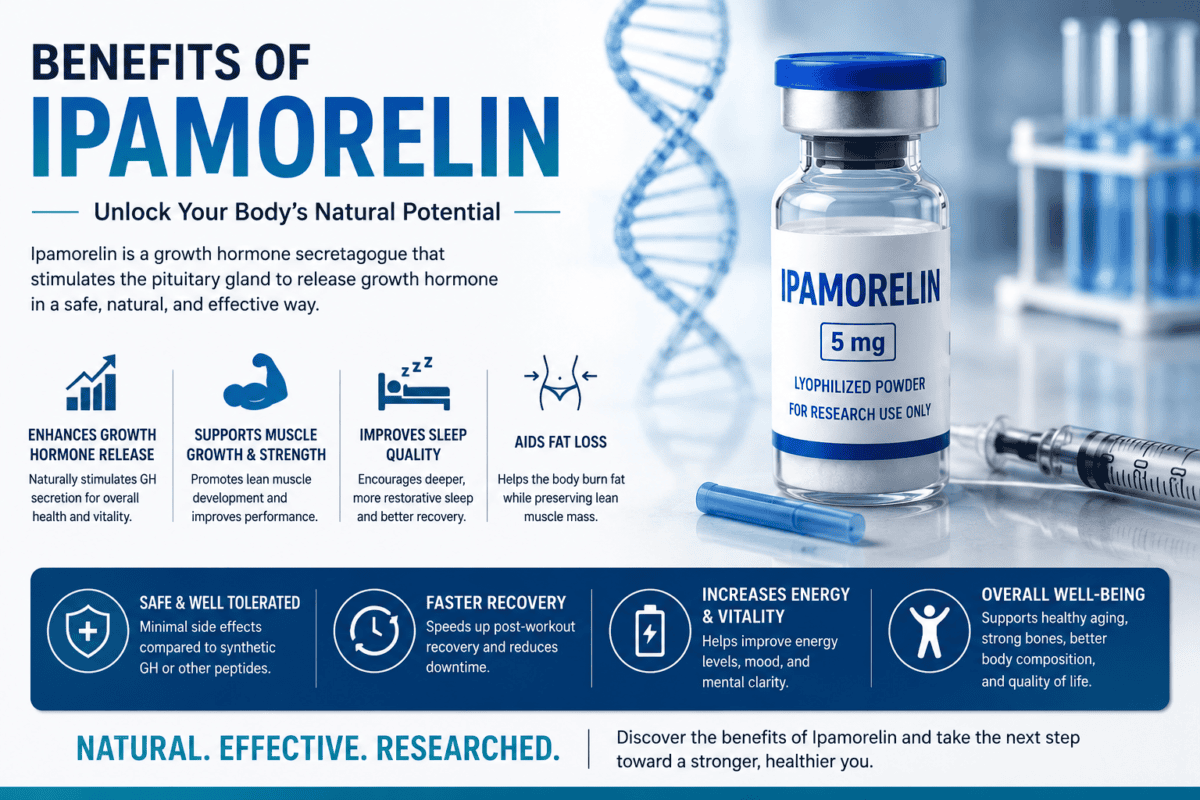
The benefits of ipamorelin that show up most often in marketing — muscle growth, fat loss, better sleep, younger-looking skin — all trace back to a real and well-documented mechanism: ipamorelin selectively triggers the pituitary to release growth hormone. That part of the story is solid.
Where the story gets shakier is the next step — the leap from “it releases GH” to “it produces these specific downstream benefits in humans.” For most of the commonly claimed benefits of ipamorelin, that leap is supported by general endocrinology and animal data, not by completed, controlled human trials of ipamorelin itself. And on the regulatory front, it’s unambiguous: ipamorelin isn’t FDA-approved, and products sold as “research use only” don’t come with pharmaceutical-grade oversight.
None of that means the compound is uninteresting from a research standpoint — ghrelin receptor biology is a genuinely active area of endocrine science. But the honest, evidence-based picture of the benefits of ipamorelin is more measured than most of what circulates online, and it’s worth carrying that distinction into any conversation you have with a healthcare professional about peptide research.
This article is for educational purposes only and does not constitute medical advice. Ipamorelin is not approved by the FDA for any human therapeutic use. Consult a licensed healthcare provider before making decisions related to your health.
References
- Raun, K., et al. (1998). Ipamorelin, the first selective growth hormone secretagogue. European Journal of Endocrinology. PubMed: 9849822
- Kojima, M., et al. (1999). Ghrelin is a growth-hormone-releasing acylated peptide from stomach. Nature. nature.com
- Arvat, E., et al. (1997). Comparative endocrine responses to GHRPs. PubMed: 9141517
- Van Cauter, E., et al. Growth hormone secretion and sleep. PubMed: 9506878
- ClinicalTrials.gov. Ipamorelin postoperative ileus study, NCT01023516. clinicaltrials.gov
- U.S. Food and Drug Administration. Certain Bulk Drug Substances for Use in Compounding That May Present Significant Safety Risks. fda.gov
- Lexology. FDA removes certain peptide bulk drug substances from Category 2 of interim 503A bulks list (2024). lexology.com
- National Institutes of Health. Growth Hormone and Insulin-Like Growth Factor-1 overview. ncbi.nlm.nih.gov