
Peptide Research
MOTS-c Dosage Protocol: Research, Safety & FDA Status
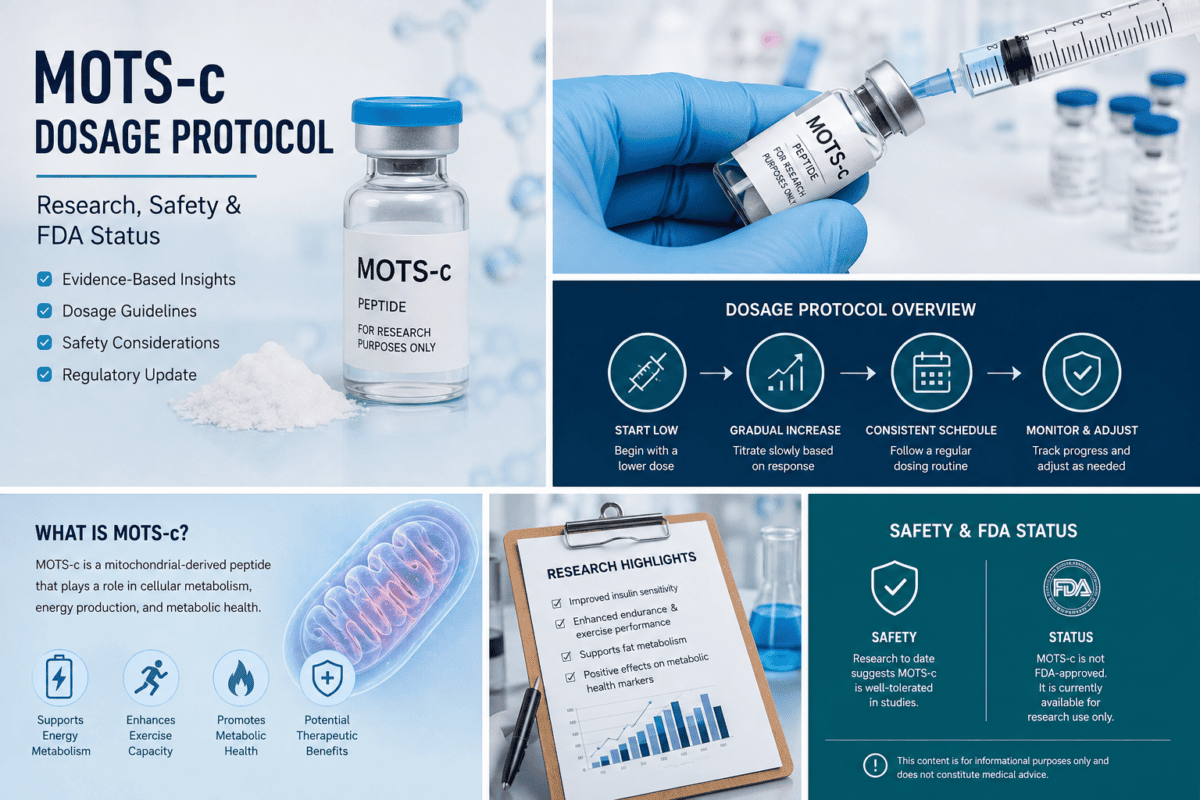
MOTS-c Dosage Protocol: What the Research Actually Shows (And What It Doesn’t)
A few years ago, a friend of mine — a competitive cyclist who spends more time reading PubMed abstracts than most people spend reading the news — sent me a message that started with, “Have you heard of this mitochondrial peptide thing?” That peptide was MOTS-c, and the question he asked next is the same one nearly everyone asks once they discover it: what’s the MOTS-c dosage protocol?
It’s a fair question. It’s also a question that, right now, doesn’t have a simple answer — at least not one anyone can responsibly hand you as a ready-to-use plan.
This guide walks through what’s actually known about the MOTS-c dosage protocol as it exists in scientific literature, why that’s a very different thing from a “recommended dose,” and what the current evidence, safety data, and regulatory status tell us. If you’re researching MOTS-c and mitochondrial peptides, comparing experimental peptide protocols, or just trying to separate hype from science, this is meant to be your grounded starting point on the MOTS-c dosage protocol question.
What Is MOTS-c, and Why Is Everyone Talking About Dosage?
MOTS-c (Mitochondrial Open Reading Frame of the 12S rRNA-c) is a small peptide encoded by mitochondrial DNA rather than nuclear DNA — which is part of what makes it scientifically interesting. Discovered in 2015 by researchers at the University of Southern California, it’s classified as a “mitochondrial-derived peptide,” and early cell and animal studies suggested it plays a role in metabolic regulation, insulin sensitivity, and how cells respond to stress (Lee et al., Cell Metabolism, 2015).
That combination — mitochondria, metabolism, stress resilience — is catnip for the longevity and biohacking community. It’s why so many people go looking for a defined MOTS-c dosage protocol, a MOTS-c peptide dosage guideline, or a longevity-stack recommendation.8
But here’s the important distinction this entire article is built around: interesting preclinical biology is not the same thing as an established, safe, human dosing schedule. Those are two very different stages of the scientific pipeline, and any MOTS-c dosage protocol you encounter right now is still firmly rooted in the earlier one.
Preclinical Research: What “Doses” Actually Means in Animal Studies
When people search for a MOTS-c dosing protocol, most of what they find traces back to animal research — primarily mouse studies — not human clinical trials.
In these studies, researchers administer MOTS-c to rodents (often via injection) at specific milligram-per-kilogram amounts to study its effects on things like glucose metabolism, exercise capacity, and age-related metabolic decline. The foundational study, published in Cell Metabolism, used MOTS-c in mice on a high-fat diet to explore effects on insulin resistance and diet-induced obesity, and found the peptide worked through activation of AMPK, the cell’s central energy-sensing pathway (Lee et al., 2015).
It’s worth being very clear about what these numbers mean and don’t mean for anyone hoping to build a real MOTS-c dosage protocol from them:
- They’re calibrated to mouse physiology, not human biology. Mouse-to-human dose conversion isn’t a simple ratio — species differ in metabolism, body surface area, and how they process peptides.
- They’re designed to answer a research question, not to establish a safe or effective human amount.
- They come from controlled lab conditions, with veterinary oversight, purity-verified compounds, and defined endpoints — nothing like a person sourcing a peptide online and self-administering it.
So when you see references to MOTS-c research dosage in scientific summaries, understand that you’re looking at experimental parameters from animal science — data points for researchers, not a template for a personal MOTS-c dosing schedule.
Has MOTS-c Been Studied in Human Clinical Trials?
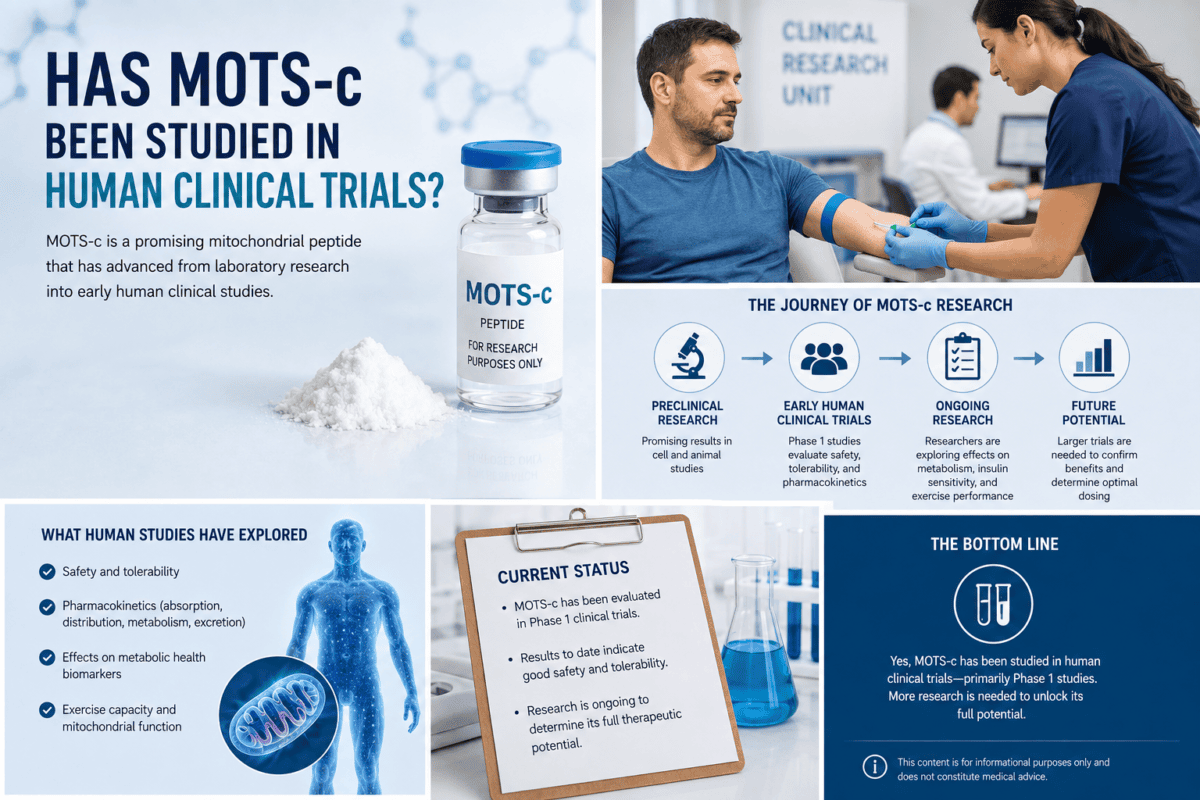
This is one of the most searched questions about MOTS-c, and the honest answer is: to a very limited extent, and not nearly enough to define a standard MOTS-c dosage protocol for the public.
A handful of registered studies on ClinicalTrials.gov reference MOTS-c — including observational research on MOTS-c levels in breast cancer survivors undergoing exercise intervention, a cardiovascular disease cohort study, and an early-phase interventional trial exploring MOTS-c’s effect on insulin sensitivity in adults with prediabetes and obesity. These exist to establish basic safety and pharmacokinetic data — how the body absorbs, processes, and clears the peptide — under strict clinical supervision, not to hand the public a usable MOTS-c administration protocol.
That’s a critical point: even where MOTS-c has been given to humans in a research setting, it happened inside a tightly controlled trial, with:
- Institutional review board (IRB) oversight
- Pharmaceutical-grade, verified compound
- Medical monitoring throughout
- A specific research question being answered — not a wellness goal being pursued
This is worlds apart from an unsupervised, self-directed MOTS-c administration protocol. Early-phase trial data tells researchers whether a compound is even reasonably safe to keep studying — it isn’t the finish line, and it isn’t a green light for public use.
Is There an FDA-Approved MOTS-c Dosage Protocol?
No — MOTS-c is not FDA-approved for any use, and there is currently no FDA-approved MOTS-c dosage protocol, dose, or indication.
That said, the regulatory picture is actively shifting, and it’s worth understanding exactly where things stand. In July 2026, the FDA’s Pharmacy Compounding Advisory Committee (PCAC) reviewed MOTS-c along with six other popular peptides to decide whether it should be added to the 503A Bulk Drug Substances List — the list that governs what licensed compounding pharmacies may legally prepare from a prescription. The committee voted 7-5 in favor of recommending MOTS-c for that list (AJMC; NPR).
A few things about that vote matter enormously for anyone reading it as validation of a MOTS-c dosing protocol:
- It’s non-binding. The FDA is not required to follow advisory committee recommendations, and even if it does, formal rulemaking is expected to take 12–24 months before anything changes in practice (Tech Times).
- FDA’s own career scientists recommended against it. Staff reviewers found no human clinical studies at all supporting MOTS-c’s proposed uses, and the committee’s yes vote went directly against that written recommendation (Drug Topics).
- It does not create an approved MOTS-c dosage protocol. Even in the best case, this pathway would eventually allow prescription-based compounding — not an approved, standardized public dosing regimen, and not a green light for research-use-only products sold online.
In the U.S., MOTS-c is generally sold — when it’s sold at all through legitimate channels — labeled “for research use only, not for human consumption.” That label reflects real regulatory reality: peptides sold this way haven’t gone through the FDA’s safety, purity, and efficacy review process required for human use (Healthline). If you see a product marketed with a specific “recommended dose” for personal use, that’s a red flag, not a scientific data point.
Why There’s No Established MOTS-c Dosing Schedule for Humans
People often ask how much MOTS-c is used in research and expect a straightforward number, the way you’d ask about ibuprofen or melatonin. A trustworthy MOTS-c dosage protocol doesn’t exist yet, for a few interlocking reasons:
1. The research base is still early. Most of what’s known comes from cell cultures and animal models. Human data is sparse, and the trials that do exist are small, early-phase, and focused on safety signals rather than defining an effective dose.
2. Pharmacokinetics in humans aren’t well mapped. How long MOTS-c stays active in the body, how it’s metabolized, and how individual factors (age, metabolic health, body composition) affect that — these are exactly the kinds of questions later-phase trials exist to answer, and MOTS-c hasn’t gotten there.
3. “Dose” depends on purpose. Even hypothetically, an amount studied for a metabolic endpoint in a lab isn’t necessarily relevant to a claim about longevity, weight loss, or exercise performance — these are different research questions requiring different trial designs, each of which would need its own MOTS-c dosage protocol validated independently.
4. Manufacturing and purity vary wildly outside clinical settings. A dose is only meaningful if you know exactly what’s in the vial. Research-grade peptides sold online are not required to meet pharmaceutical purity or potency standards, and no federal body verifies purity, potency, or sterility before the product reaches a buyer (Medical Daily).
Safety Considerations and Known Risk Signals
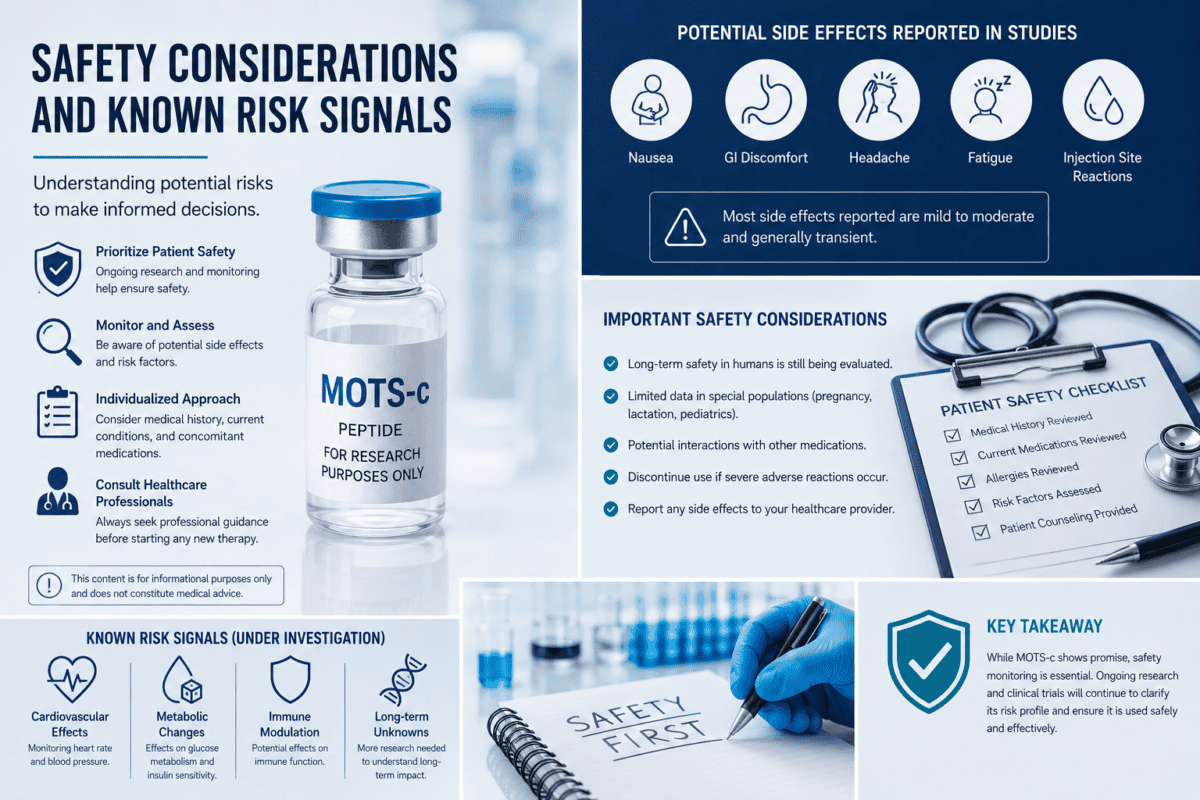
Because MOTS-c hasn’t gone through late-stage human trials, there is no comprehensive human safety profile — no large-scale data on long-term effects, drug interactions, or rare adverse events. What exists are early observations, most from animal studies and small early-phase human research, plus general caution that applies to unregulated peptides as a category:
- Sourcing risk: Unregulated peptide vendors are not held to pharmaceutical manufacturing standards. Contamination, incorrect concentration, and mislabeling are documented problems across the research-peptide market generally, and the FDA has issued warning letters and import alerts against producers of bulk peptides over sterility violations (Medical Daily).
- Injection-related risk: Any injectable substance carries risk of infection or local reaction if not handled with sterile technique — a nontrivial concern for anyone using an unsupervised MOTS-c administration protocol.
- Unknown interactions: Without robust human trials, there’s no reliable data on how MOTS-c might interact with existing medications or health conditions.
- Unknown long-term effects: Short-term animal or early human data cannot tell you what happens with sustained, repeated use over months or years.
- Anti-doping status: MOTS-c is flagged as a WADA-prohibited substance due to its exercise-mimetic, AMPK-activating properties, a status that predates any FDA action (Drug Topics).
A useful way to think about it: early safety data in a small trial is like the first few minutes of a much longer movie. It can tell you nothing catastrophic happened right away — it can’t tell you how the story ends, and it certainly can’t hand you a validated MOTS-c dosage protocol.
What About Half-Life and Frequency Questions?
Search interest around MOTS-c half-life and dosing reflects a reasonable instinct — half-life normally informs how often a compound needs to be administered to maintain a stable effect. The problem is that human pharmacokinetic data for MOTS-c is limited to what’s emerged from small early-phase research, and it hasn’t been replicated or generalized enough to support any confident, publishable statement about a standard human half-life — let alone translate that into a real-world MOTS-c dosage protocol or administration frequency.
Any specific frequency claims you encounter (daily, several times weekly, cyclical protocols) circulating in wellness or biohacking spaces are not sourced from established clinical pharmacology. They’re extrapolations, and treating them as a real MOTS-c dosing protocol skips over exactly the research step that would make them trustworthy.
Dose Escalation, Starting Amounts, and Maintenance — Why These Concepts Don’t Apply Yet
In approved medicine, concepts like a “starting dose” that’s later titrated to a “maintenance dose,” or structured dose-escalation protocols, come out of Phase I and Phase II clinical trials specifically designed to map out that curve — the lowest effective amount, the point of diminishing returns, the threshold where risk starts to outweigh benefit.
MOTS-c hasn’t been through that process at scale. So when content describes a “starting dose” or “maintenance dose” as part of a MOTS-c dosage protocol, it’s borrowing the language of established pharmacology without the underlying trial data that gives those terms meaning. That’s worth sitting with, because it’s easy to mistake a confident-sounding structure for confident-sounding evidence.
Expert and Research Community Perspective

Researchers studying mitochondrial-derived peptides have generally been careful to frame MOTS-c as a promising area of metabolic and aging research — not a ready-to-use therapeutic. The original discovery team’s published work, and subsequent academic reviews of mitochondrial-derived peptides, consistently describe MOTS-c’s human therapeutic potential as requiring “further investigation” and “additional clinical trials” before any translational use can be considered.
Even FDA staff reviewing MOTS-c’s case for expanded pharmacy access in 2026 concluded there were no human clinical studies at all supporting its proposed uses for obesity and osteoporosis (Drug Topics). That’s the standard, appropriately cautious language of a field that’s still building its evidence base — and it’s a useful anchor whenever a product page or forum post describing a MOTS-c dosage protocol sounds more certain than the underlying science actually is.
Can MOTS-c Be Used for Weight Loss?
This is one of the most common questions, largely because early animal research linked MOTS-c to improved insulin sensitivity and metabolic markers associated with obesity (Lee et al., 2015). That’s genuinely interesting preclinical biology. It is not the same as evidence that MOTS-c causes weight loss in humans, at any dose, under any protocol. No human trial has established an effective MOTS-c dosage protocol for weight loss, and FDA reviewers specifically flagged obesity as one of the indications lacking supporting human data.
How Long Does MOTS-c Stay in the Body — and What Happens With Too Much?
Precise human clearance data isn’t well established in published literature, for the same reason a defined dosing schedule isn’t: the trials that would answer this definitively haven’t been completed at scale. Similarly, there’s no robust human data describing what happens with an excessive amount — which is itself a safety concern, not a reassurance. An absence of documented overdose cases most likely reflects how little controlled human exposure exists, not evidence that any particular MOTS-c dosage protocol carries low risk.
What Factors Would Matter If a Human MOTS-c Dosage Protocol Is Eventually Established?
Looking at how similar peptides have progressed through clinical development, a future validated MOTS-c dosing guideline would likely need to account for:
- Body weight and composition
- Baseline metabolic health
- Route of administration and formulation
- Concurrent medications
- Age and individual variation in mitochondrial function
None of that exists yet in a validated, published human protocol — but it’s the kind of variable set legitimate trials are built to test before any MOTS-c dosage protocol could be responsibly published.
Comparing MOTS-c to Other Experimental Peptides
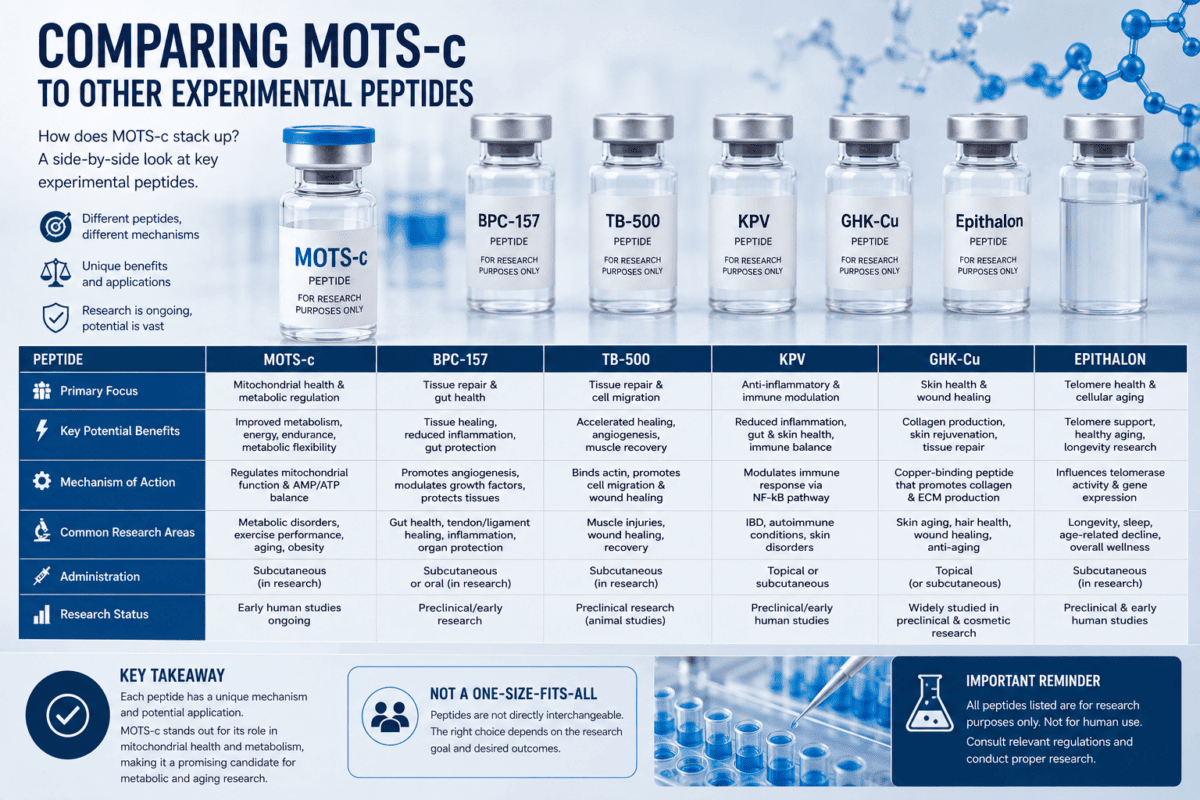
For readers comparing experimental peptide protocols across the mitochondrial-derived peptide family (MOTS-c sits alongside others like humanin), the common thread is the same: intriguing preclinical signal, minimal human trial data, no established regulatory approval, and a research community actively working to close that gap rather than declaring it closed. Notably, MOTS-c was reviewed alongside BPC-157, TB-500, KPV, Semax, and Epitalon in the FDA’s 2026 compounding review, and FDA staff found similarly thin human evidence across most of that group (AJMC). That pattern is worth recognizing whenever a new peptide trend appears — the presence of a lab study, or even a favorable advisory vote, doesn’t imply the presence of a safe, established MOTS-c dosage protocol.
The Bottom Line
If you take one thing away from this guide, let it be this: there is currently no established, medically validated MOTS-c dosage protocol for human use. What exists is early, genuinely interesting preclinical and early-phase research — animal studies, small early human trials, a non-binding 2026 advisory recommendation, and a regulatory status that still firmly places MOTS-c in “research use only” territory, not an FDA-approved product with a defined MOTS-c dosage protocol.
For researchers, clinicians, and science-minded readers, that’s not a discouraging conclusion — it’s an accurate one, and it’s exactly the kind of clarity that lets you evaluate future MOTS-c research (and any claims about a MOTS-c dosage protocol you encounter) with a sharper, more informed eye.
External Resources and Citations
- Lee, C. et al. (2015). The mitochondrial-derived peptide MOTS-c promotes metabolic homeostasis and reduces obesity and insulin resistance. Cell Metabolism / PubMed record
- ClinicalTrials.gov search results for MOTS-c
- Study Details, NCT04027712 — Platelet Reactivity, β-amyloid, MOTS-c and Mortality of Type II Diabetics With CAD
- MOTS-c for Improving Insulin Sensitivity in Adults With Prediabetes and Overweight/Obesity — trial record
- Effect of aerobic and resistance exercise on the mitochondrial peptide MOTS-c in breast cancer survivors, Scientific Reports
- FDA Panel Backs 6 Peptides for Compounding, AJMC
- FDA panel supports broadening access to peptides popular on the gray market, NPR
- FDA Panel Backs Peptide BPC-157 for Compounding in 8-6 Vote Over Scientists’ Objections, Tech Times
- FDA Panel to Evaluate 7 Popular Peptides for Compounding Substances List, Drug Topics
- Understanding Peptides: FDA-Approved vs. Research Chemicals, Healthline
- Peptides Labeled for Research Only Are Not Approved Medicines and People Are Injecting Them Anyway, Medical Daily
This article is intended for general educational and research-informational purposes only. It does not constitute medical advice, and nothing here should be interpreted as a recommendation to obtain, administer, or use MOTS-c. Anyone considering involvement in peptide research should consult qualified medical or research professionals and rely on properly regulated, IRB-approved channels.