Peptide Research
Selank Peptide Benefits & Dosage: What Research Shows

Selank Peptide Benefits and Research: What the Evidence Says About This Experimental Compound
If you’ve spent any time in peptide research forums or scrolling through biohacking communities, you’ve probably run into the name Selank peptide. It shows up in conversations about stress, focus, and mood — usually alongside a lot of enthusiasm and, unfortunately, not always a lot of accuracy.
So let’s slow down and look at this properly.
This guide walks through what is Selank peptide, where it came from, how does Selank peptide work, what preclinical and limited human research actually suggests, and — just as importantly — what remains unknown. We’ll also talk honestly about selank peptide safety, its regulatory status, and how it compares to a compound it’s often mentioned in the same breath as: Semax.
Understanding selank peptide benefits and dosage together — rather than treating them as separate questions — is really the only way to approach this compound responsibly, since a claimed benefit is only meaningful in the context of the specific dose, route, and population it was studied in.
One thing this article will not do is give you dosing instructions. Selank is not an approved medication, and there’s no medically established human dosing standard for it. Anyone telling you otherwise — with confident numbers and schedules — is going beyond what the science currently supports. What we can do is look at how researchers have studied selank peptide benefits and dosage in controlled settings, and why that distinction matters.
What Is Selank Peptide?
Selank peptide is a synthetic peptide developed in Russia in the 1990s by researchers at the Institute of Molecular Genetics, as part of a broader program studying peptide-based approaches to anxiety and stress. It’s structurally related to tuftsin, a naturally occurring immunomodulatory peptide found in the body, but with a short additional amino acid sequence added to increase its stability.
Think of tuftsin as a message that the body sends but degrades almost as soon as it’s delivered — gone before it can do much. Selank was engineered to be a longer-lasting version of that message, resistant to the enzymes that would normally break it down within minutes.
In Russia, a formulation of Selank has been registered as a pharmaceutical product for anxiety-related conditions and is available by prescription in that country. It has not gone through FDA review or approval in the United States, which is a distinction we’ll come back to.
For researchers outside Russia, selank peptide research is typically conducted in laboratory and preclinical settings, using it as a tool to understand peptide pharmacology, the GABAergic and serotonergic systems, and stress-response biology — not as a consumer wellness product.
One of the foundational studies behind this body of work is a clinical comparison of Selank and the benzodiazepine medazepam in patients with generalized anxiety disorder and neurasthenia, published via PubMed, which remains a frequently cited reference point for selank peptide benefits and dosage discussions in the scientific literature.
How Does Selank Peptide Work? The Proposed Mechanism of Action

The honest answer is: researchers have proposed several mechanisms, and the full picture isn’t settled.
The selank peptide mechanism of action appears to involve a few interconnected systems:
1. Influence on GABA and Serotonin Pathways
Some studies suggest Selank may modulate GABAergic transmission — the brain’s primary “calming” neurotransmitter system — while also affecting serotonin and its metabolites. This is part of why it’s been studied in the context of anxiety-like behavior in animal models.
2. Effects on Brain-Derived Neurotrophic Factor (BDNF)
A number of preclinical studies have looked at Selank’s relationship to BDNF, a protein involved in neuroplasticity — essentially, the brain’s ability to form and reorganize connections. Researchers studying selank peptide for cognitive function have pointed to this pathway as a possible explanation for observed effects on learning and memory in animal models.
3. Immunomodulatory Activity
Because of its structural relationship to tuftsin, Selank has also been examined for effects on immune signaling, including cytokine expression. This is a secondary area of interest compared to its neurological research applications, but it’s part of the broader pharmacological profile researchers are still mapping out.
It’s worth being clear here: most of this mechanistic work comes from animal and cell-based studies. Extrapolating those findings directly to humans is where a lot of online claims get ahead of the actual evidence.
For readers who want to go deeper on the molecular side, a peer-reviewed analysis of Selank’s GABA-receptor interactions is available via PubMed, and a gene-expression study examining Selank’s effect on GABAergic neurotransmission genes is published on PMC. Both are useful primary sources for anyone researching selank peptide benefits and dosage at the mechanistic level rather than relying on secondary summaries.
What Are the Potential Benefits of Selank Peptide?
This is the section most readers come for, so let’s go through it area by area — while being upfront about the strength (or limits) of the evidence behind each claim.
Selank Peptide for Anxiety Research
The largest body of selank peptide research relates to anxiety. In Russian clinical studies — conducted under that country’s pharmaceutical approval framework — Selank was evaluated in patients with generalized anxiety disorder, with researchers reporting anxiolytic (anxiety-reducing) effects comparable in some measures to established benzodiazepine medications, but without the same sedative or dependency profile described in those trials.
That’s a notable finding, but it comes with caveats: these studies were conducted within a specific regulatory and clinical system, using pharmaceutical-grade formulations, under medical supervision — a very different context from someone sourcing a research compound independently.
A related rat study published on PMC examined how Selank interacts with the benzodiazepine diazepam under chronic stress conditions, adding another data point to the broader picture of selank peptide benefits and dosage in preclinical stress models.
Selank Peptide for Stress Research
Preclinical models have also explored selank peptide for stress research, looking at how animals exposed to stress-inducing conditions responded when given Selank beforehand. Some of this research points to changes in stress-hormone activity and stress-related behaviors, including a study on alcohol-withdrawal-induced anxiety in rats available via PubMed. Again — this is animal-model data, and translating it cleanly to human stress management isn’t something the current research base fully supports.
Selank Peptide for Cognitive Function and Focus
Interest in selank peptide for focus and broader cognitive performance largely traces back to the BDNF-related findings mentioned earlier. Some animal studies suggest improved performance on memory and learning tasks. Human data here is much thinner, and claims about focus or nootropic-style benefits in people are, at this point, more extrapolation than established finding.
Selank Peptide for Sleep
Sleep is one of the more anecdotal areas of interest. Some anxiety-related research has noted secondary improvements in sleep quality — which would make sense if anxiety was disrupting sleep in the first place — but there isn’t a dedicated, robust body of research specifically targeting selank peptide for sleep as a primary outcome.
Selank Peptide Benefits at a Glance
Because evidence quality varies so much by claim, here’s a quick summary table showing where each proposed benefit currently stands in the research — a snapshot of selank peptide benefits and dosage context side by side:
| Proposed Benefit | Type of Evidence | Strength of Evidence |
|---|---|---|
| Anxiety reduction | Russian human clinical studies + animal models | Moderate (clinical, but limited outside Russia) |
| Stress response modulation | Animal/preclinical models | Preliminary |
| Cognitive function / memory | Animal models (BDNF-linked) | Preliminary |
| Focus / mental clarity | Extrapolated from cognitive research | Anecdotal / limited direct study |
| Sleep quality | Secondary observation in anxiety studies | Anecdotal |
| Immune modulation | Preclinical / mechanistic studies | Preliminary, secondary interest |
None of these ratings should be read as a green light for use — they’re a snapshot of where the science currently sits, not a recommendation.
Selank Peptide Effects: What Research Participants and Animal Models Have Shown
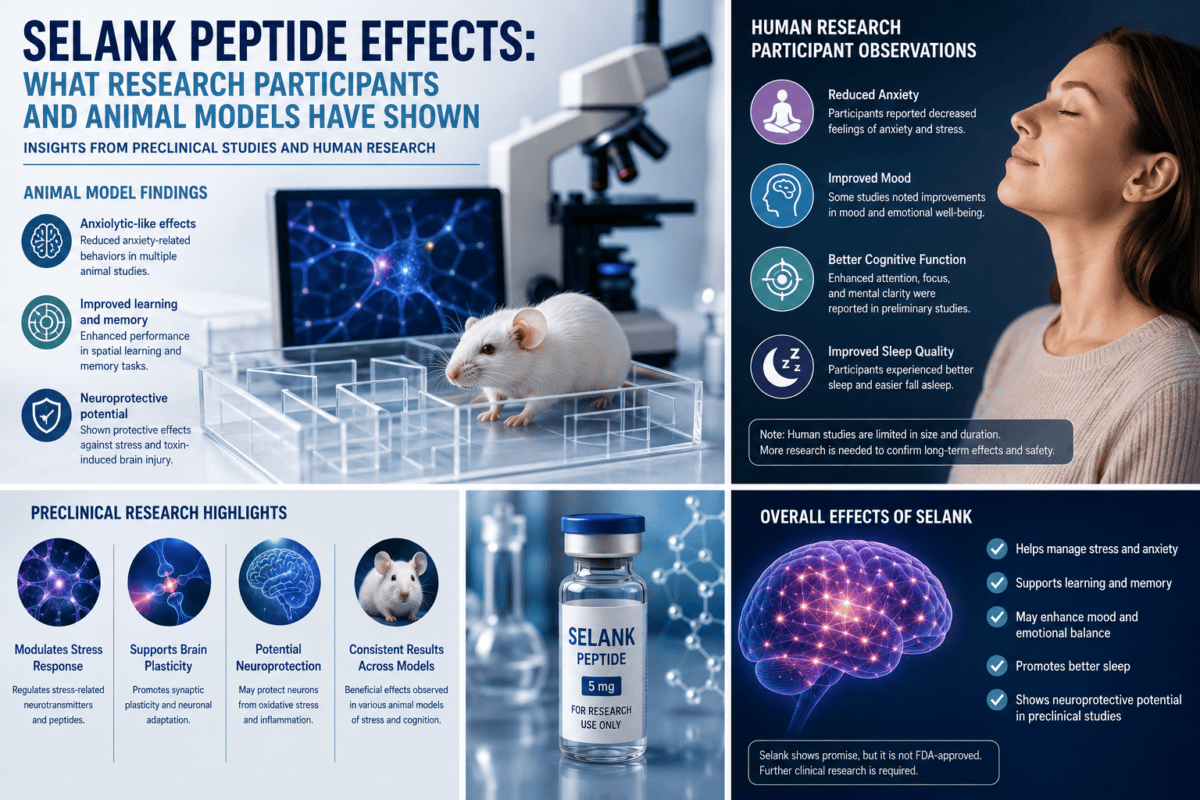
Across the available literature, the selank peptide effects most commonly discussed include:
- Reduced anxiety-like behavior in animal models and, in Russian clinical research, in human participants
- Changes in markers associated with the stress response
- Effects on neuroplasticity markers like BDNF
- Some reported influence on cognitive task performance in preclinical settings
- Immunomodulatory activity, of secondary research interest
It’s worth pausing on something important: how long does Selank take to work, and how long does Selank last, are questions that come up constantly — and the honest answer is that this varies significantly across the study designs that exist, and there’s no consensus figure that applies universally, especially outside controlled clinical settings. Anyone giving you a precise, confident timeline is speaking beyond what the research actually establishes. This is exactly why selank peptide benefits and dosage need to be discussed together rather than as separate topics — a reported effect without its corresponding study conditions isn’t really actionable information.
Has Selank Been Studied in Human Clinical Trials?
Yes, to an extent — but it’s important to understand the context.
Selank human clinical trials have primarily taken place in Russia, tied to its registration as a pharmaceutical product there for anxiety-related conditions. These studies were conducted under that country’s clinical and regulatory framework.
Outside Russia, Selank has not been through the kind of large-scale, peer-reviewed, multi-phase human clinical trial process that the FDA requires for drug approval in the United States. Much of the research available in English-language scientific literature is preclinical — meaning animal or in-vitro studies — rather than large human trials.
A 2017 rat study published in Behavioral Neurology, available on PubMed, is a good example of the kind of preclinical work still filling out the picture on selank peptide benefits and dosage — long after the original Russian clinical trials were completed.
This gap is exactly why is Selank FDA approved is such a common — and important — question.
Is Selank FDA Approved? Understanding the Regulatory Status
No. Selank is not FDA approved for any use in the United States. It has no approved medical indication, is not manufactured under FDA drug-quality standards for human consumption, and is not legally marketed as a supplement, drug, or treatment for any condition in the U.S.
Where it is legally sold in the U.S. research space, it’s offered strictly as a research chemical — meaning it’s intended for laboratory and scientific study, not for human ingestion, injection, or nasal use outside of a supervised clinical trial.
This regulatory reality matters more than it might seem. A compound with promising preclinical data is not the same thing as a compound that’s been proven safe and effective for people through the review process designed to catch exactly the kinds of risks that don’t show up until later. That gap is the entire reason clinical trials exist in the first place — and it’s exactly why selank peptide benefits and dosage can’t be treated as settled facts the way they would be for an approved medication.
Is Selank Peptide Safe? What We Actually Know
Selank peptide safety is one of the most under-discussed parts of the conversation, and it deserves real attention — and it’s inseparable from the dosage question, since risk profiles in the literature are always tied to a specific amount, route, and population rather than to the compound in the abstract. That’s the core reason selank peptide benefits and dosage should always be read together, never as isolated claims.
Within the Russian clinical research described above, Selank was reported to be generally well tolerated in the study populations involved, with a different side-effect profile than benzodiazepine comparators — notably without the sedation, motor impairment, or dependency concerns associated with that drug class in those trials.
That’s meaningfully different from saying it’s broadly established as safe for unsupervised use. A few things are worth being clear-eyed about:
- Formulation and purity matter enormously. Clinical research uses pharmaceutical-grade material manufactured and tested to strict standards. Research-chemical sourcing does not carry that same guarantee.
- Long-term human safety data outside the specific clinical trial population is limited. We don’t have the decades of accumulated post-market surveillance that approved medications have.
- Interaction with other medications or health conditions hasn’t been comprehensively studied in the way it would need to be for general safety guidance.
What About Selank Peptide Side Effects?
Reported selank peptide side effects in the available research have generally been described as mild in the clinical studies that exist — but “mild in a supervised trial” and “predictable for anyone using it independently” are not the same claim, and it would be misleading to present them as equivalent.
If you’re a researcher, student, or professional working with this compound in a laboratory context, standard research-chemical handling and biosafety practices apply — the same way they would for any experimental compound not intended for human consumption.
Reported Effects vs. Unknowns: A Quick Comparison
| What Clinical Research Reported | What Remains Unknown |
|---|---|
| Generally described as well tolerated in Russian trial populations | Long-term effects outside those specific trials |
| No sedation or motor impairment reported in trial comparisons | Interactions with other medications or supplements |
| No dependency signals noted in the clinical studies reviewed | Safety across diverse populations (age, pregnancy, comorbidities) |
| Mild side effects reported in supervised settings | Consistency/purity of independently sourced material |
Selank Peptide Administration: How Has It Been Studied?
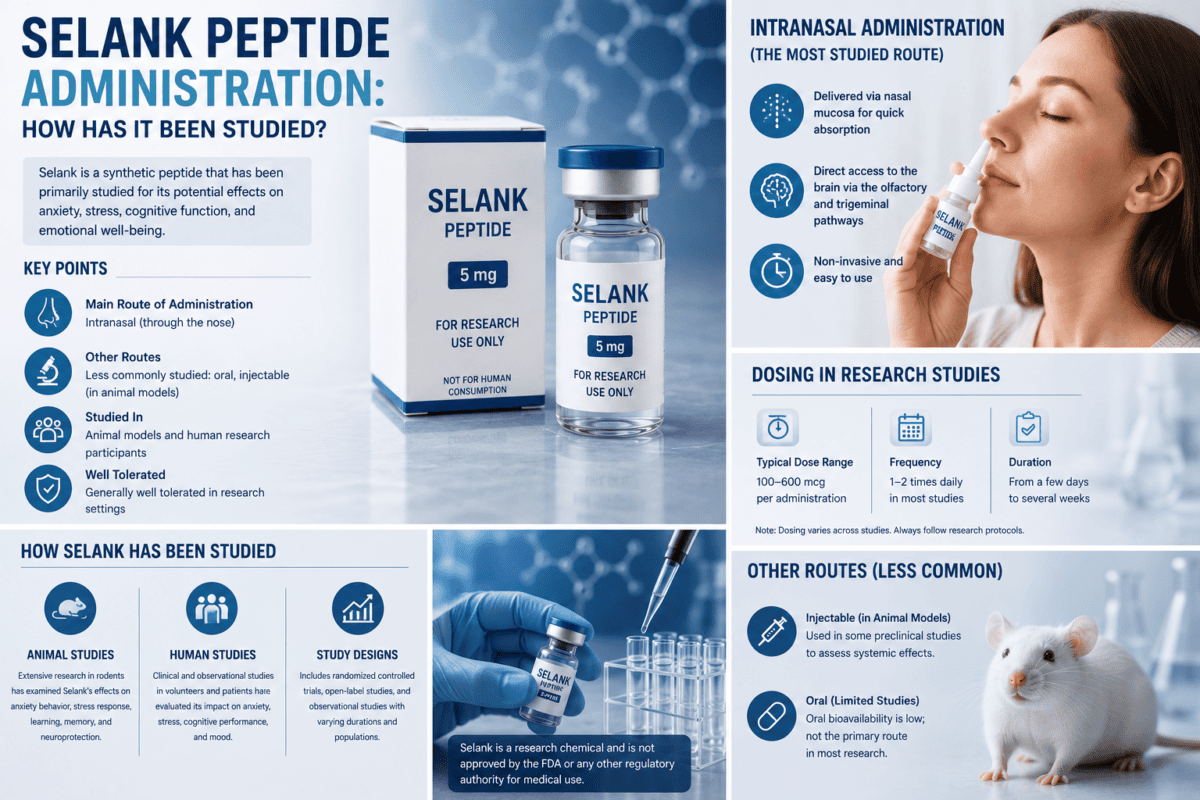
In the clinical and preclinical literature, Selank has typically been studied via intranasal administration, which relates to why terms like selank peptide nasal spray dosage show up frequently in search behavior. Some laboratory research has also examined injectable routes in animal models.
The table below summarizes, in general terms, how research protocols differ by setting — without listing specific amounts, since those numbers were calibrated to a particular study population, formulation, and monitoring context that doesn’t transfer safely to independent use:
| Research Context | Typical Route Studied | Oversight Level | Applicable to General Use? |
|---|---|---|---|
| Russian clinical trials | Intranasal | Medical supervision, registered pharmaceutical formulation | No — clinical population only |
| International preclinical studies | Intranasal, injectable (animal models) | Institutional/laboratory protocol | No — animal-model data |
| Independent research-chemical use | Not clinically validated | None | Not a validated research protocol |
We’re intentionally not providing specific dosing figures, schedules, or administration instructions here — not because the information doesn’t exist in research papers, but because research protocols used in controlled laboratory or clinical trial settings are not the same as safe, validated guidance for general or self-directed use. A dose used in a specific study, on a specific population, under medical monitoring, isn’t a number that safely generalizes to “how much should a person take.”
If you’re engaging with Selank in a genuine research capacity — as a scientist, student, or lab professional — the appropriate approach is referring directly to peer-reviewed study protocols and working within an institutional or regulatory framework with appropriate oversight, not adapting numbers found in a blog post or forum thread.
Selank Peptide Dosage: Why There’s No “Standard” Answer
Search interest around selank peptide dosage, selank dosage, selank dosing schedule, selank starting dose, and selank maintenance dose is high — which makes sense, since dosage is usually the first practical question people have about any compound. But it’s exactly where the biggest gap sits between what’s searched for and what’s actually established. In short, selank peptide benefits and dosage are two halves of the same unanswered question for anyone outside a formal clinical or laboratory setting.
Here’s why a single, reliable “selank peptide benefits dosage” figure doesn’t exist for general use:
| Factor | Why It Matters |
|---|---|
| No FDA-approved labeling | Approved drugs come with dosing derived from Phase I–III trials; Selank has none in the U.S. |
| Formulation varies by source | Clinical-grade material in Russian trials isn’t equivalent to research-chemical sourcing elsewhere |
| Study doses are population-specific | A dose studied in clinical patients under monitoring isn’t validated for a general, unsupervised user |
| No standardized “maintenance” protocol published | Long-term/repeated-use dosing hasn’t been established outside specific trial designs |
| Route affects absorption | Intranasal vs. injectable routes behave differently — a figure for one isn’t interchangeable with the other |
If you’re looking for selank peptide dosage protocol information for genuine research purposes, the reliable path is the primary literature itself — peer-reviewed studies will report exactly what was used in that specific trial, for that specific population — rather than secondary sources repackaging those numbers as general-use advice.
Selank vs Semax: How Do They Compare?
Selank vs Semax is one of the most frequent comparisons in this space, since both are Russian-developed peptides studied for cognitive and stress-related effects.
| Selank | Semax | |
|---|---|---|
| Structural basis | Derived from tuftsin | Derived from ACTH fragment |
| Primary research focus | Anxiety, stress response | Cognitive performance, neuroprotection |
| Russian regulatory status | Registered pharmaceutical product | Registered pharmaceutical product |
| U.S. regulatory status | Not FDA approved | Not FDA approved |
| Human trial base | Primarily Russian clinical studies | Primarily Russian clinical studies |
In practice, the two are often discussed together because they share a research lineage and country of origin, but they’re pharmacologically distinct compounds with different proposed mechanisms. Neither should be treated as more broadly “proven” than the other for general use — both sit in roughly the same position: promising research subjects with a regulatory and evidence gap between “studied” and “established as safe and effective.”
Can Selank Be Used Daily? A Question the Research Doesn’t Fully Answer
This is a common question, and it’s worth addressing directly: the existing research base doesn’t provide a clear, generalizable answer about daily use outside of the specific clinical trial protocols conducted in Russia. Long-term, repeated-use safety data in broader populations is one of the more significant gaps in the current literature on this compound.
What Should You Know Before Considering Selank Peptide?
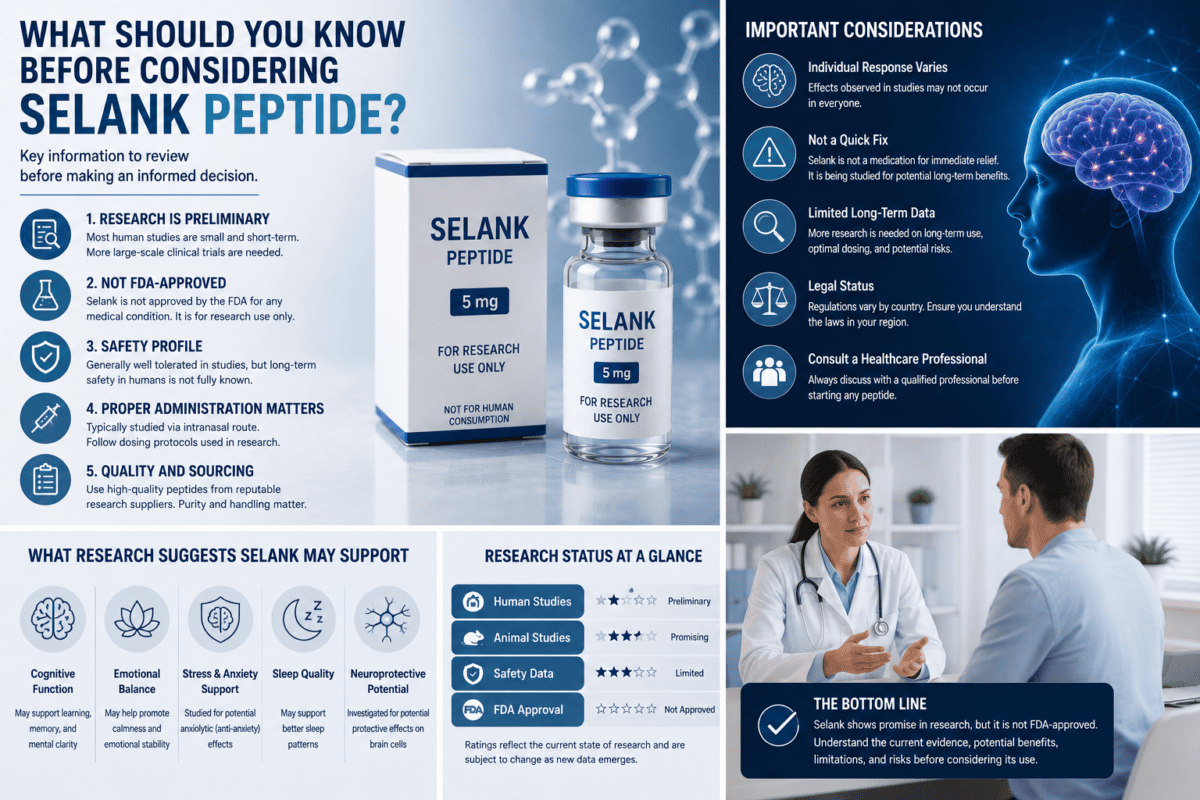
If you’re approaching selank peptide research — whether as a curious reader, a student, or someone working in a lab setting — a few grounding points are worth keeping in mind:
- Preclinical promise isn’t the same as proven benefit. Animal studies and cell models are valuable early signals, not conclusions.
- Country-specific approval isn’t the same as FDA approval. Selank’s status as a registered product in Russia doesn’t translate to U.S. regulatory approval or oversight.
- Research-chemical availability is not a safety endorsement. Legal availability for laboratory research purposes is a different category from being cleared for human use.
- The literature has real gaps. Long-term safety, drug interactions, and effects across diverse populations remain under-studied.
- “What a study used” is not “what’s medically recommended.” Research protocols are designed for specific scientific questions, not as consumer usage instructions.
None of this is meant to dismiss the genuine scientific interest here — Selank is a legitimately interesting subject in peptide pharmacology, and the mechanistic questions researchers are chasing (GABAergic modulation, BDNF, stress-hormone regulation) are meaningful ones. But interesting research and settled medical guidance are two very different things, and conflating them does readers a disservice.
The Bottom Line
Selank peptide benefits discussed in the research — around anxiety, stress response, and cognitive function — stem largely from a combination of Russian clinical research and international preclinical studies. The findings are genuinely worth paying attention to as science, particularly the work on GABAergic activity and BDNF-related neuroplasticity.
At the same time, Selank is not FDA approved, human clinical data outside of Russia is limited, and there’s no medically established dosing standard for general or self-directed use. Anyone presenting confident dosing numbers as though they were established medical guidance is overstating what the current evidence supports. Put simply: selank peptide benefits and dosage are well documented within specific studies, but not translated into general-use guidance — and that gap is the single most important thing to understand about this compound.
If you’re a researcher, the right next step is engaging directly with the primary literature and working within a proper institutional or clinical research framework. If you’re a curious reader, the most useful thing you can walk away with is a clear-eyed sense of where the science currently stands on selank peptide benefits and dosage — genuinely promising in places, meaningfully incomplete in others.
References and Further Reading
- Semenova et al., “Efficacy and possible mechanisms of action of a new peptide anxiolytic selank in the therapy of generalized anxiety disorders and neurasthenia”, PubMed
- “Efficacy of peptide anxiolytic selank during modeling of withdrawal syndrome in rats with stable alcoholic motivation”, PubMed
- Shevchenko & Myasoedov, “Peptide-based Anxiolytics: The Molecular Aspects of Heptapeptide Selank Biological Activity”, PubMed
- “GABA, Selank, and Olanzapine Affect the Expression of Genes Involved in GABAergic Neurotransmission in IMR-32 Cells”, PMC
- “Peptide Selank Enhances the Effect of Diazepam in Reducing Anxiety in Unpredictable Chronic Mild Stress Conditions in Rats”, Behavioral Neurology, PMC
- “Peptide Selank Enhances the Effect of Diazepam…”, PubMed
This article is for educational and informational purposes only. It does not constitute medical advice, and Selank is not approved for human use in the United States. Consult a qualified healthcare professional before making decisions related to your health.