
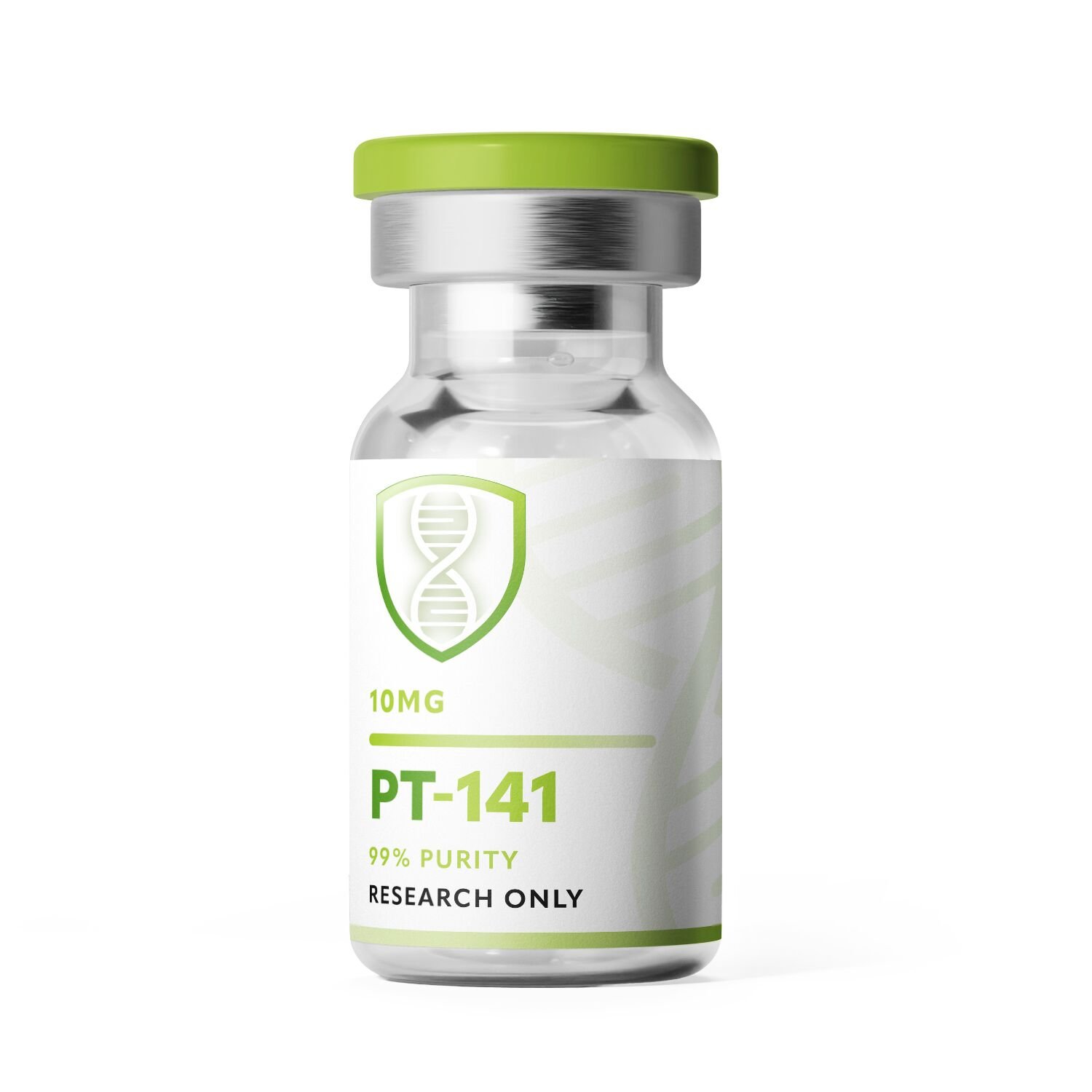
Buy PT 141: Research-Grade Bremelanotide Peptide
Are you looking to buy PT 141 from a manufacturer that verifies purity on every batch? Sino Research Peptide Manufacturer supplies PT-141, also known as Bremelanotide — a cyclic synthetic peptide composed of seven amino acids.(1) Researchers study this compound extensively for its agonistic action on melanocortin receptors, similar to the natural hormone alpha-MSH.(2)
What Is PT-141 Peptide?
PT-141 forms as a by-product of Melanotan II metabolism. Initial studies suggested melanocortin hormones may regulate various physiological functions, and when researchers presented the isolated hormone to test animals, they reported elevated reproductive function responses — one of the primary areas of current PT-141 research.
Buy PT 141 and Melanocortin Receptor Activity
Studies show Buy PT-141 exhibits agonistic properties toward melanocortin receptors, specifically MC3R and MC4R, potentially resulting in elevated central nervous system reactions.
MC3R appears primarily expressed in the brain, especially within the hypothalamus, and research suggests it may play a role in energy homeostasis. Researchers hypothesize MC3R may modulate other melanocortin receptor actions in this region while influencing feeding behavior, appetite, food intake, and metabolic processes tied to glucose and lipid regulation.(3)
MC4R, meanwhile, appears essential to appetite control. When activated in the brain, this receptor is thought to contribute to appetite regulation and energy expenditure, with activation potentially increasing energy output. Researchers have also tentatively linked MC4R to reproductive function, particularly regarding penile tissue regulation and reproductive behavior.(4)
Published research suggests that after binding MC3R and MC4R receptors, PT-141 appears to activate hypothalamic neurons, leading to increased immunoreactivity. Neurons in surrounding central nervous system regions may also become stimulated, reportedly leading to sexual arousal responses in murine models.(2)
Chemical Makeup of PT-141
| Property | Detail |
|---|---|
| Molecular Formula | C50H68N14O10 |
| Molecular Weight | 1025.18 g/mol |
| Other Known Titles | Bremelanotide |
Buy PT-141 Peptide Research and Clinical Studies
Buy PT 141 Initial Research
An early 2000s study examined PT-141’s potential impact on sexual behavior in murine models.(5) After presentation, female rats appeared to exhibit elevated sexual desire without changes to sexual pace, lumbar lordosis, or other sexually related behaviors. Researchers concluded the peptide didn’t directly impact generalized motor activation, but instead may have selective pharmacological effects on the central nervous system, particularly melanocortin receptor activity.
As the study authors noted, PT-141’s ability to enhance solicitation across two distinct testing environments indicates the effect is selective and stable, suggesting central melanocortin systems form part of the neurochemical network involved in appetitive sexual behavior in female rats.(5)
Buy PT 141 and Arousal Research
Research suggests MC4R activation by PT-141 may upregulate nitric oxide (NO) production in penile tissues, potentially improving erection response.(6) Since PT-141 is a Melanotan-2 (MT-II) metabolite, both compounds appear to activate the same receptors, and melanocortin agonists have been linked to concentration-related increases in cavernosal pressure.
In this research, SHU 9119 — a non-selective MC3R/MC4R antagonist — didn’t significantly impact cavernosal or systemic blood pressure on its own, but appeared to negate the cavernosal pressure increases that melanocortin agonists potentially induced. SHU 9119 also appeared to inhibit the depressor response likely produced by melanocortin agonists. Separately, introducing a combination of phentolamine mesylate, papaverine, and PGE1 directly into cavernosal tissue led to a 4-fold increase in cavernosal pressure.
Researchers also explored the NO-cyclic GMP-dependent pathway’s role in melanocortin agonist-induced cavernosal pressure changes, using bilateral pudendal nerve transection and NO synthase inhibition (L-NAME). Results showed that removing the pudendal nerves or pretreating with L-NAME negated the intracavernosal pressure increases likely induced by melanocortin agonists in anesthetized murine models. Researchers tentatively inferred that central melanocortin receptor activation might increase cavernosal pressure through neuronal NO release.(6)
Buy PT-141 and Central Nervous System Research
Studies have examined PT-141’s potential within the central nervous system and specific brain regions.(7) One study used murine models with rich female reproductive hormone levels, focusing on appetitive behaviors (increased pace and agitation) and consummatory behaviors (lordosis). After peptide presentation, researchers observed increased appetitive solicitation behavior without changes to sexual pace or lordosis.
Researchers noted PT-141’s actions following both peripheral introduction and direct introduction into the lateral ventricles or medial preoptic area (mPOA), though not the ventromedial hypothalamus. The mPOA may represent a significant region for appetitive sexual behavior display across species, though this theory remains under exploration. Peripheral PT-141 introduction appeared to activate the mPOA and other hypothalamic and limbic brain regions associated with sexual behavior, with researchers hypothesizing the peptide might function through dopamine terminal activation in the mPOA.
As the study authors noted, PT-141 appears to possess the behavioral, pharmacological, and neuroanatomical specificity required to potentially influence sexual function.(7)
A separate randomized, double-blinded, placebo-controlled, crossover clinical investigation used psychometric, functional neuroimaging, and hormonal analyses to evaluate MC4R agonism’s impact on sexual brain processing. Results indicated MC4R agonists like PT-141 might elevate sexual desire for up to 24 hours compared to placebo.
During functional neuroimaging, MC4R agonism appeared to amplify activity in cerebellar and supplementary motor areas while potentially deactivating the secondary somatosensory cortex during erotic stimuli exposure, compared to placebo. Researchers also observed potentially boosted functional connectivity between the amygdala and insula during erotic stimuli exposure. Based on these findings, researchers proposed that MC4R agonists might augment sexual brain processing, offering further insight into how compounds like PT-141 may influence sexual behavior.(8)
Where to Buy PT 141 Peptide
PT-141 Peptide Where to Buy: What to Check First
When you compare where to buy PT-141 peptide, purity documentation and consistent synthesis methods should top your checklist. Sino Research Peptide Manufacturer verifies identity and purity on every batch.
Buy PT 141 Online at Sino Research Peptide Manufacturer
Whether your research focuses on melanocortin receptor pharmacology, CNS signaling, or reproductive function studies, Sino Research Peptide Manufacturer ships high-purity PT-141 backed by rigorous internal quality checks.
Order / Buy PT 141 Peptide Today
Ready to add PT-141 to your research pipeline? Sino Research Peptide Manufacturer makes ordering simple, with consistent, research-grade material for every study.
PT-141 peptide is available for research and laboratory purposes only. Please review and adhere to our Terms and Conditions before ordering.
References:
- Pfaus, J., Giuliano, F., & Gelez, H. (2007). Bremelanotide: an overview of preclinical CNS effects on female sexual function. The journal of sexual medicine, 4 Suppl 4, 269–279. https://doi.org/10.1111/j.1743-6109.2007.00610.x
- National Center for Biotechnology Information (2023). PubChem Compound Summary for CID 9941379, Bremelanotide. Retrieved August 10, 2023 from https://pubchem.ncbi.nlm.nih.gov/compound/Bremelanotide.
- Molinoff, P. B., Shadiack, A. M., Earle, D., Diamond, L. E., & Quon, C. Y. (2003). PT-141: a melanocortin agonist for the treatment of sexual dysfunction. Annals of the New York Academy of Sciences, 994, 96–102. https://doi.org/10.1111/j.1749-6632.2003.tb03167.x
- Renquist, B. J., Lippert, R. N., Sebag, J. A., Ellacott, K. L., & Cone, R. D. (2011). Physiological roles of the melanocortin MC₃ receptor. European journal of pharmacology, 660(1), 13–20. https://doi.org/10.1016/j.ejphar.2010.12.025
- Adan, R. A., Tiesjema, B., Hillebrand, J. J., la Fleur, S. E., Kas, M. J., & de Krom, M. (2006). The MC4 receptor and control of appetite. British journal of pharmacology, 149(7), 815–827. https://doi.org/10.1038/sj.bjp.0706929
- Pfaus, J. G., Shadiack, A., Van Soest, T., Tse, M., & Molinoff, P. (2004). Selective facilitation of sexual solicitation in the female rat by a melanocortin receptor agonist. Proceedings of the National Academy of Sciences of the United States of America, 101(27), 10201–10204. https://doi.org/10.1073/pnas.0400491101
- Vemulapalli, R., Kurowski, S., Salisbury, B., Parker, E., & Davis, H. (2001). Activation of central melanocortin receptors by MT-II increases cavernosal pressure in rabbits by the neuronal release of NO. British journal of pharmacology, 134(8), 1705–1710. https://doi.org/10.1038/sj.bjp.0704437
- Thurston, L., Hunjan, T., Mills, E. G., Wall, M. B., Ertl, N., Phylactou, M., Muzi, B., Patel, B., Alexander, E. C., Suladze, S., Modi, M., Eng, P. C., Bassett, P. A., Abbara, A., Goldmeier, D., Comninos, A. N., & Dhillo, W. S. (2022). Melanocortin 4 receptor agonism enhances sexual brain processing in women with hypoactive sexual desire disorder. The Journal of clinical investigation, 132(19), e152341. https://doi.org/10.1172/JCI152341
| PT-141 | 5mg*10vials, 10mg*10vials |
|---|
1 review for PT-141
 PT-141
Related products
All Peptides
All Peptides
All Peptides
All Peptides
All Peptides
All Peptides
All Peptides
All Peptides
Great product, quick delivery, excellent communication